2026-06-21 · Blog
An external creative department for a manufacturer — from collection launch to trade show
Details
End-to-end creative for a manufacturer — renders, packshots and animation for a collection launch on one subscription. The Method Creative process, with Stargres as the example.

A collection launch isn't one file
It's dozens of pieces that in the same week have to reach Instagram, a distributor's catalogue, the screen on a trade-show stand and the sales team — and look as though one hand made them.
In practice they usually don't. One freelancer does the renders, another the animation, a photo studio the packshots, and the consistency gets lost somewhere between emails. The more collections launch at once, the greater the drift — and at a premium manufacturer the first person to notice is the architect the material is meant to reach.
With us a manufacturer doesn't order individual renders. They get one coherent system of material, run through one process from brief to finished library. That's how we built the visual campaign for Stargres's 13 new collections. Here's that process step by step.
Why “several suppliers” stops working at a launch
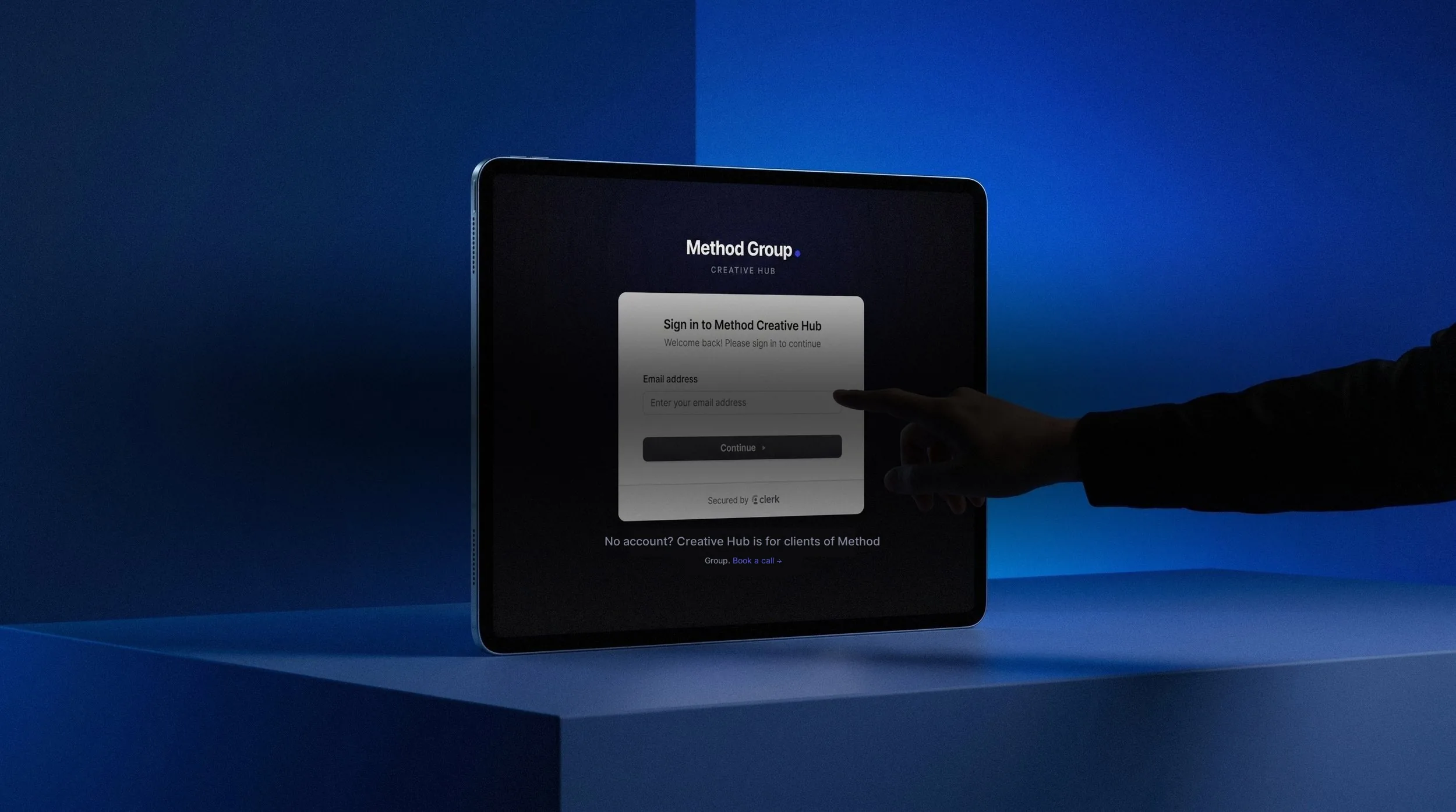
All your projects in one place
See how it works: Method Creative Hub
The problem isn't the quality of any single render. It's the scale.
One product has to work on social media, with distributors, in print, in e-commerce and at trade shows. Every channel needs a different format from the same source. Multiply that by 13 collections launching at once and you have hundreds of pieces that nobody holds together by hand without drift.
And the stakes are higher than with an ordinary product. Architects and designers spot anything false in a fraction of a second — for that audience, mediocre material works against the brand. A premium manufacturer doesn't need handsome pictures from five different suppliers. They need one creative partner instead of many — and a system that holds one character across the whole thing.
How we work: the 5D methodology
Every job — whether a campaign for a developer or a series of renders for a manufacturer — goes through the same five-phase process. We call it Method 5D. Five phases beginning with D, and every cycle closes with data that drives the next. It isn't a linear “brief to file” service but a loop that understands your brand better with each turn. It's also our process for working with a creative agency, set out step by step — and the foundation of a model in which we are a manufacturer's creative department on a subscription rather than a one-off supplier.
In come the objectives, the material and the context. If we're starting fresh, we run a visual communication workshop: we settle the look of the renders, the feel of the animation, emotion versus technical detail, the audiences. If we already know each other, a short brief will do.
At Stargres the workshops were joined by a visit to the factory in Końskie — the team assessed the tiles in person, the finishes, the lappato surfaces, the colour in real light, so as to reproduce them faithfully in the renders.
The approved brief becomes a scope, a schedule and a price in Method Creative Points. This is the phase that kills the chaos: the client knows what they're paying for, how we'll measure the result and what happens next. You know the cost before anything begins.
Concepts and directions take shape — at Stargres, 42 unique architectural concepts, each matched to the character of a particular collection. At this cheap stage we test some things in AI tools, because a direction is worth checking while a change costs pennies rather than after full production. But that's only quick reconnaissance.
The final quality — fidelity of colour, texture and light — is made by people in full 3D. At Stargres, where architects judge the material, all the final renders were made in 3D precisely because there, anything false isn't forgiven in even one frame.
The approved concept becomes full production, consistent with the brand system: at Stargres, 672 renders, 210 packshots and over 56 minutes of animation. From one shot we generate variants for different formats and channels without costs rising in step — that's how you scale production without chaos and without new hires.
Material arrives continuously, against fixed dates: social launches, distributor packs, trade shows. All of it lands in one library in Method Creative Hub, ready for every channel. What remains at the end isn't files in a folder but a system plus data.
The fifth D isn't the end — why we work in a loop
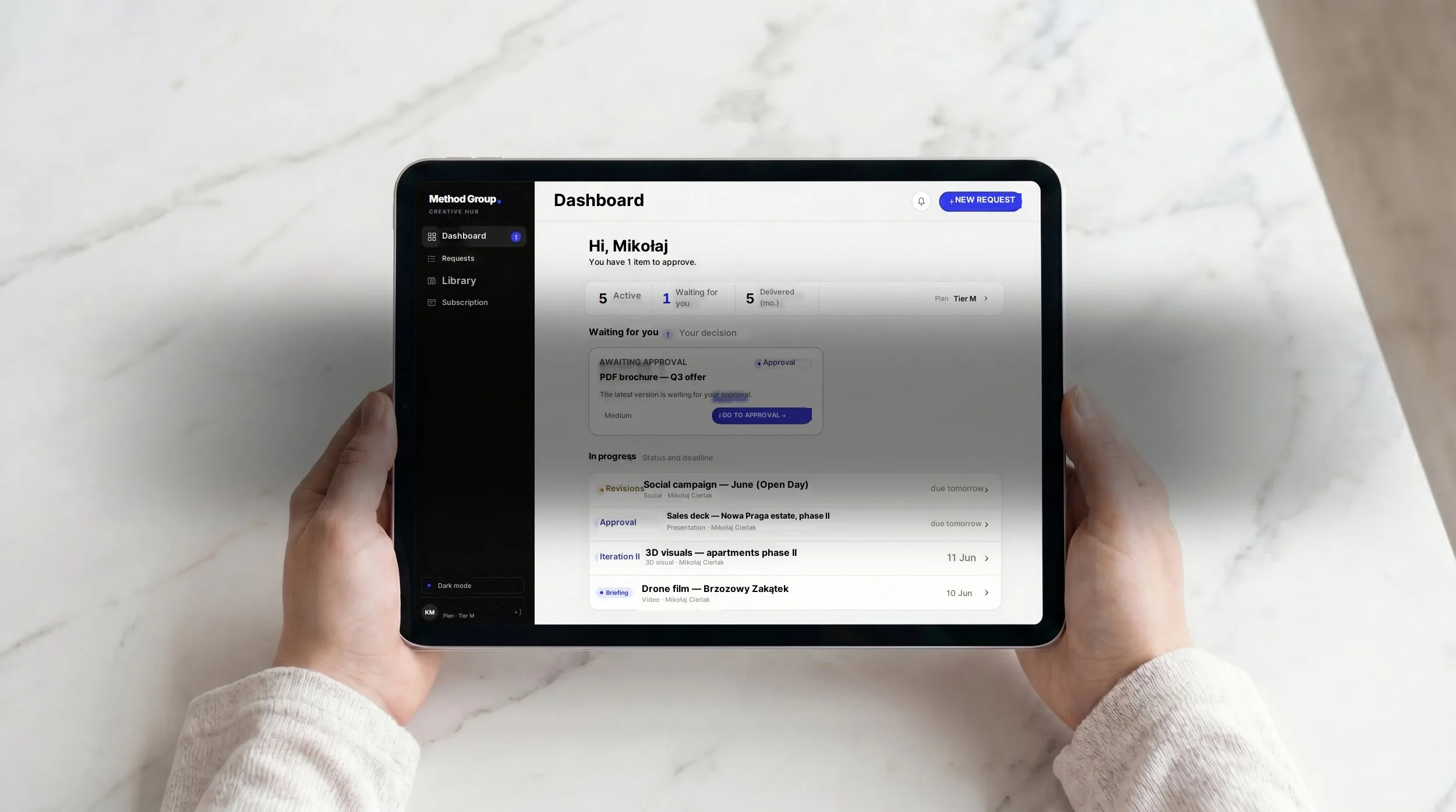
24/7 access for you and your team
See how it works: Method Creative Hub
Delivery doesn't close the matter. It feeds the next Discover: the conclusions, the performance data and what we know about the brand go back to the start. Which is why subscription model makes sense at all — every cycle starts wiser than the last. You build an ever deeper library and an understanding of the brand that a studio doing one-off jobs will never accumulate.
Stargres is the proof. The brand came back for, among other things, the ArchiDAY 2025 branding, and every new project starts from what we already know about them.
How it worked in practice: Stargres, 13 collections, the trade-show season

Stargres was bringing to market one of the widest launches in its history — 13 new collections under “New for Spring 2026”, feeding social media, distributors, print and the promotion at Warsaw Home & Contract 2025.
The whole 5D process in one project: workshops and the visit to Końskie (Discover), scope and schedule against the trade show (Define), 42 architectural concepts (Design), 672 renders plus 210 packshots plus animation (Develop), continuous delivery and the library in the Hub (Delivery).
The result: a coherent system instead of files scattered across drives — Stargres's marketing and sales teams now work from one set. See the full Stargres case.
What we do for manufacturers
For us, end-to-end creative for a manufacturer is one Method Creative subscription — a complete package for a collection launch with no separate quote per format. For a maker of building materials — tiles, finishes, systems — that means:
Product visualisation (photorealistic product rendering) — the product in a full setting and in context, ready for campaigns and catalogues.
3D campaigns — complete sets of material for a collection launch, consistent across every channel.
Hero and product animation — from short social formats to longer brand and commercial pieces.
3D packshots — with no photo shoot, built from a model or documentation; for e-commerce, product sheets and the catalogue.
Product material for distributors and trade shows — from displays and screens to brochures and print.
Branding and visual communication — workshops and a system that holds one character across the whole range.
The common thread: one render, many formats. From one source come versions for social media, the website, the PDF catalogue and presentations — with no surcharge per channel.
What you're left with

A dedicated team from day one
See how it works: Method Creative Hub
Not a bundle of files on WeTransfer. A library that lives in one panel, with the current version always in one place, open to marketing and sales. A coherent visual system for the whole product brand, not loose files on drives. The commercial model is predictable: a fixed subscription, every job priced in points before it starts, first versions within 48 hours, and unused points rolling over.
That's the difference between a file and a system — and it's what makes the material keep working long after production ends.
We'll show you how we put it together as one system — convert a typical project of yours into points and tell you straight whether the model makes sense for your company. No commitment and no 40-slide deck.
A model in which, instead of building your own team or commissioning material from several suppliers, you have one external creative department — ready from day one, on a subscription. We take over all the visual production: renders, packshots, animation, trade-show material and print. No recruitment, no onboarding, no bottleneck of one person.
It means one partner handles everything visual around the product — from communications strategy, through renders and animation, to material for distributors and trade shows. All on one subscription, in one visual character, with no separate quote per format.
Several suppliers means several styles, several deadlines and consistency that drifts apart between emails. One creative partner instead of many gives you one point of responsibility and one character across every channel — which at a full collection launch is the difference between a system and chaos.
We make marketing material for building-materials manufacturers with the care this industry demands: fidelity of colour, texture and finish. At Stargres the team went to the factory in Końskie to assess the tiles in person, because the material is judged by architects, who spot anything false in a fraction of a second. See the full Stargres case.
Marketing material for a product launch is best built through one process rather than gathered from different suppliers at the last minute. With us it runs through Method 5D — from understanding the collection, through concepts, to full production delivered in stages against fixed dates: social media, distributors, trade shows.
A complete package for a collection launch means room-set renders, packshots, product and commercial animation, plus material for trade shows and distributors — all visually consistent. At Stargres that was 672 renders, 210 packshots and over 56 minutes of animation across 13 collections.
We run it through Method 5D — five phases: Discover (gather and understand), Define (set the direction and the price), Design (show the concepts), Develop (produce), Delivery (implement, and the system stays). At every stage you know where we are and what comes next — and the fifth phase feeds the next cycle with data.
Yes. We act as a manufacturer's creative department on a subscription: every job is priced in points before it starts, first versions arrive within 48 hours, and unused points roll over. You know the cost before anything begins — no contract addenda and no surprises on the invoice.
Creative as a Service for a manufacturer means access to a whole creative team for a fixed subscription, instead of recruiting, onboarding and managing. You get the full range — renders, animation, branding, sales material — in one place. More about the model: What Creative-as-a-Service is.
Yes — product material for distributors and trade shows is one of the main reasons manufacturers engage us. The same set of renders feeds the distributor's catalogue, the trade-show display, social media and print, because it all lives in one library and holds one character.
A coherent visual system for a product brand starts by settling its character in a workshop and ends with one library that marketing and sales both use. So every collection and every channel speaks one language. Why that matters: a file or a system.
Both — but for different things. AI tools are for testing a direction quickly at the cheap concept stage. The final quality, where fidelity of colour and texture matters, is made by people in full 3D. At Stargres the final renders were made in 3D for exactly that reason.