2026-04-12 · Blog
How to scale creative production without chaos and without new hires
Details
Companies that want to produce more often scale the chaos rather than the content. Here's why a shared view of the brand matters more than the number of designers — and how Method brings it into one place.

Want to produce more? First check whether everyone is talking about the same brand
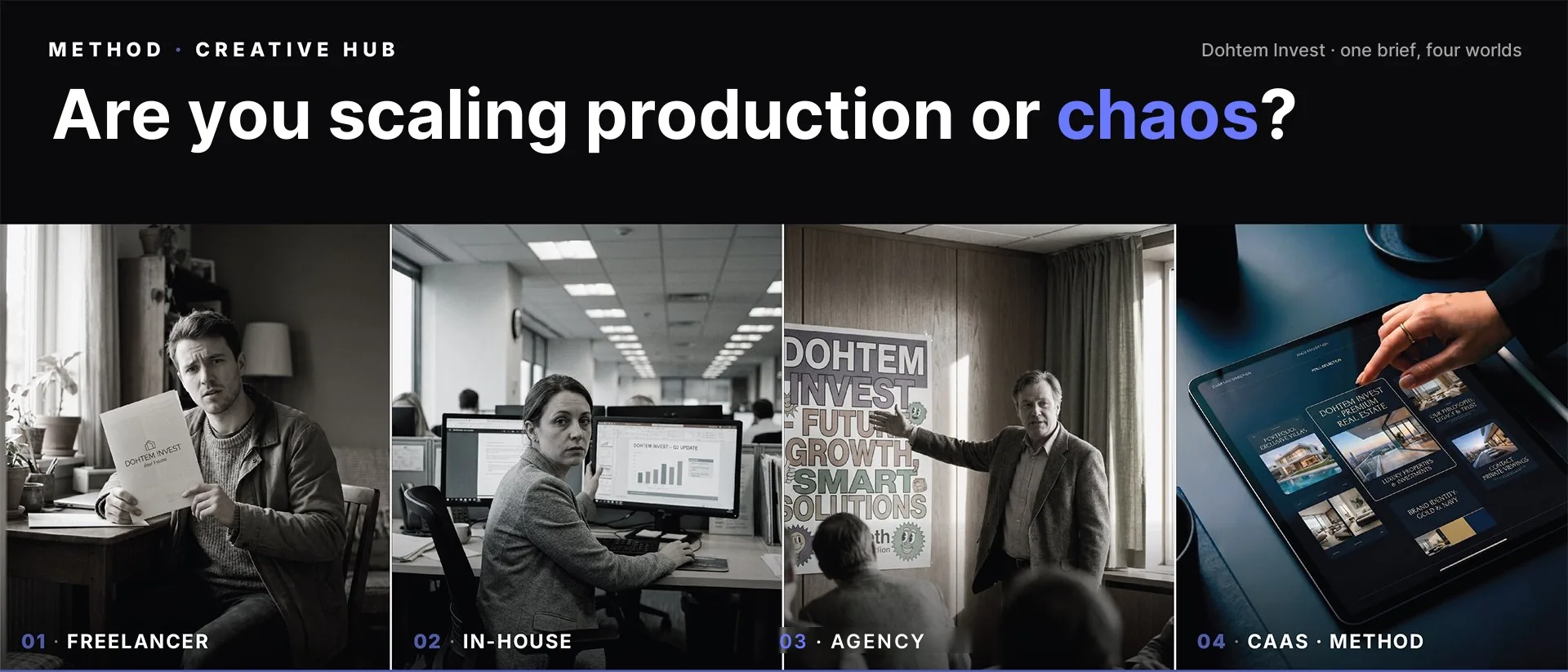
A company decides to scale its creative production. It hires another person. Adds a freelancer. Signs with an agency. Three months later it has more material — and more chaos than before.
Every asset looks slightly different. The tone changes by channel. The Meta ad says one thing and the website another. The client brochure doesn't match the sales presentation.
This isn't a problem of headcount. It's a problem of having no shared language about the brand.
Why companies scale chaos instead of content
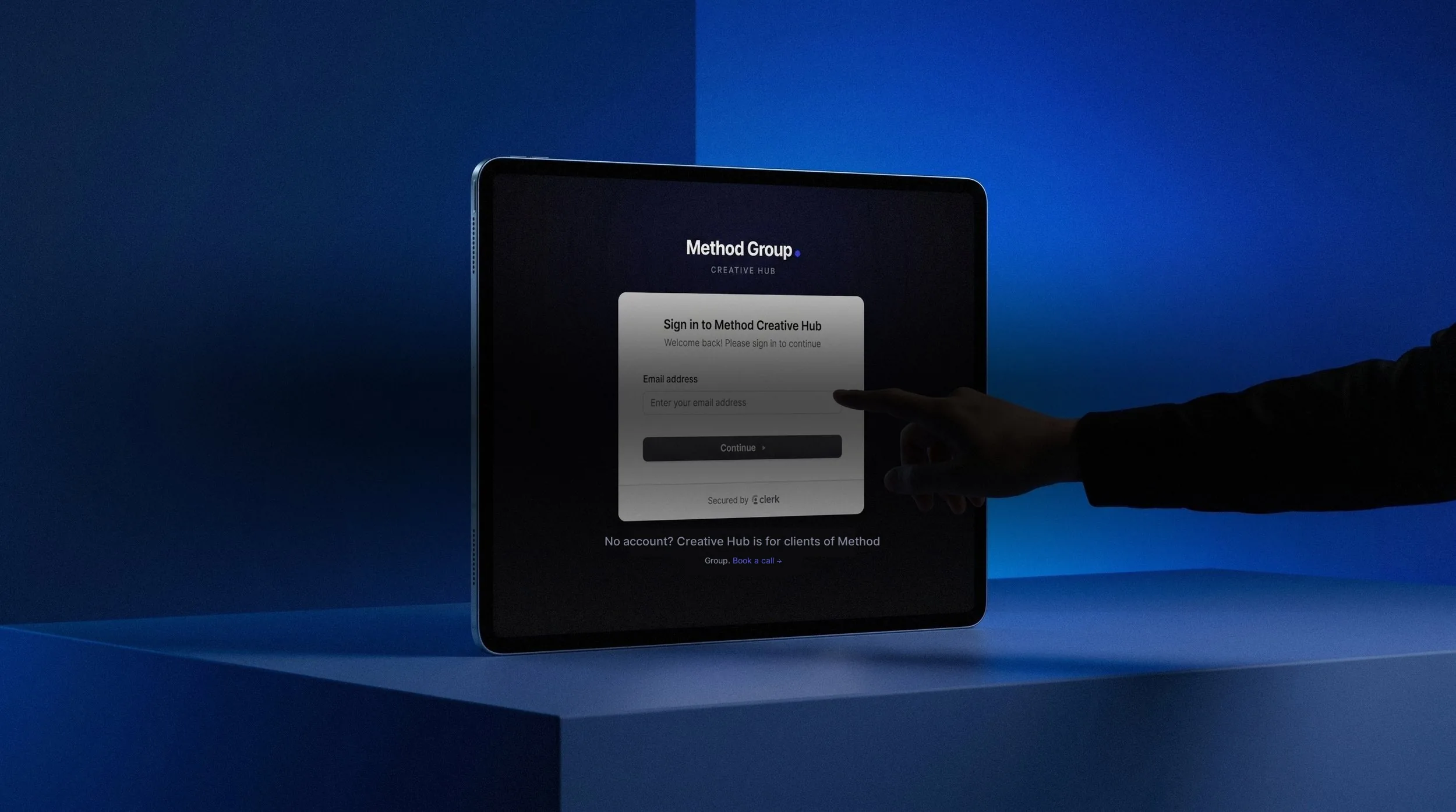
Your projects in one place
See how it works: Method Creative Hub
When a company says “we want to produce more” — it usually means the finished pieces. We need reels for social. Product renders. Landing pages, fast. Assets for Google Display.
Those are legitimate needs. But every time we dig deeper it turns out the CEO understands the brand differently from the head of marketing, the head of marketing differently from the head of sales, and all of them differently from the people producing the material.
We worked with a development company in Warsaw — the meeting included the head of design, the head of marketing, the head of sales and the CEO. Four people from one company. If you'd drawn a map of how each of them saw the brand, perhaps 20% would have overlapped. The rest was four different pictures of who the company is and how it should look.
Until that was named and aligned, every production decision produced a different outcome. Every piece was slightly different. Every supplier read the brief their own way.
After the workshops and agreeing a direction together, everything the company produced — from leaflets through the website to Meta and Google Ads campaigns — started to look like one coherent system.
The problem nobody names out loud
In conversations with companies, hardly anyone ever says: “our problem is that we don't share a view of our own brand.” What you hear instead:
“We have too many suppliers and it's hard to coordinate.” “The boss wants it cheaper and we can't find anyone good.” “The material comes out, but somehow it doesn't look the way it should.”
Those are symptoms. There's one cause: no shared input.
Which brings us to something rarely said out loud about creative production: the quality of the output depends directly on the quality of the input.
It sounds obvious. In practice it means you can give the same brief to ten different firms and get ten different readings. Not because they're bad. Because the brief was incomplete, since the company itself wasn't clear about its own visual identity.
A well-defined input — a shared view, clear brand rules, everyone senior understanding where the brand is going — is the foundation for scaling. Without it you're scaling noise.
Why this matters even more in the age of AI

AI tools have changed the pace of creative production dramatically. What used to take weeks can now be produced in hours.
But AI doesn't fix a bad input — it amplifies it. If what goes in is an inconsistent view of the brand, AI will produce more inconsistent material faster than ever.
The paradox of scaling with AI is that the faster you can produce, the more it matters that you know exactly what you want to produce. Speed without direction isn't an advantage — it's going round in circles faster.
So before you start any production — AI or otherwise — you need a shared, precise input. Briefs that say not only what you want but why, for whom, and in what visual and communicative context.
What it looks like in practice, before we start producing
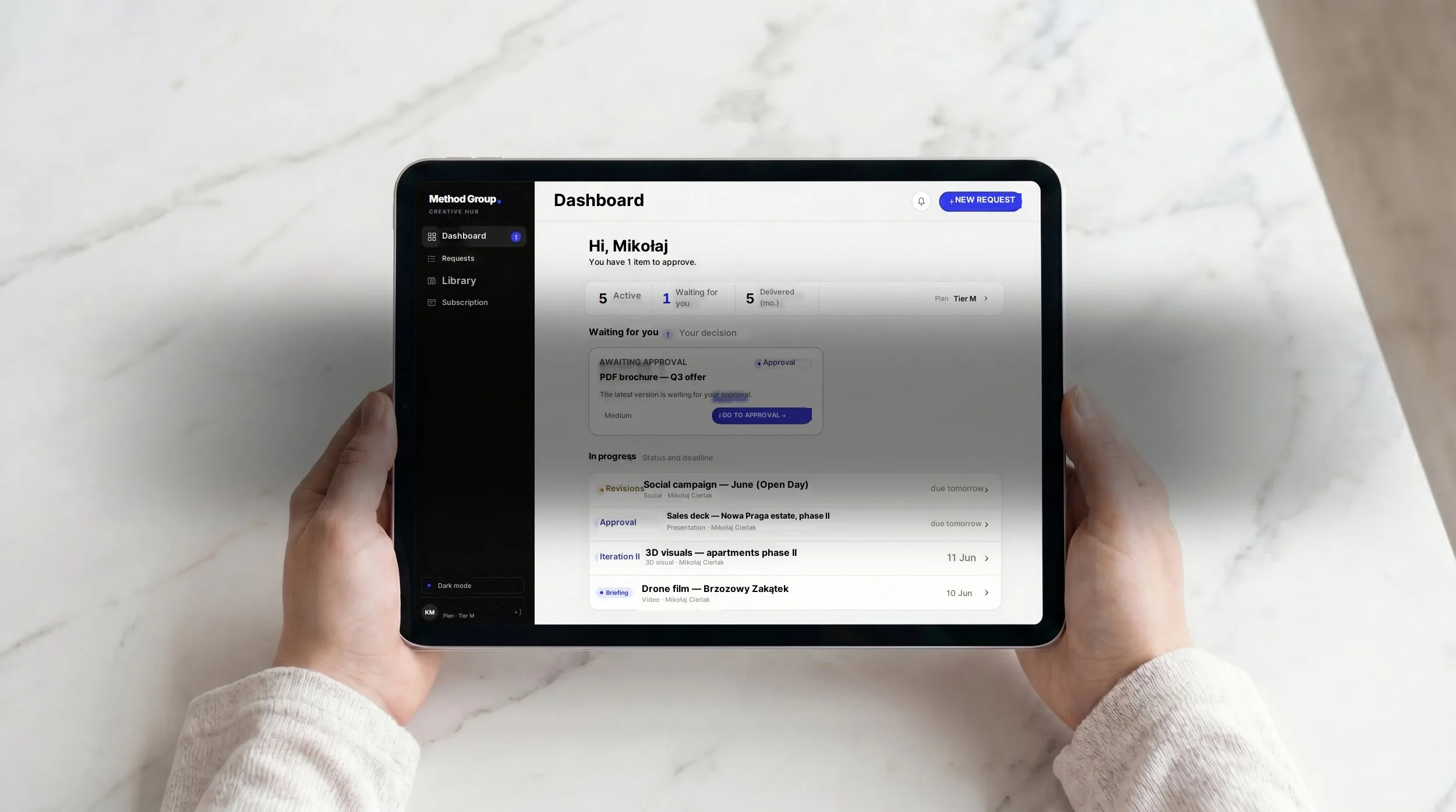
24/7 access for you and your team
See how it works: Method Creative Hub
When a company comes to Method asking about scaling production, our first step isn't to switch on the asset machine.
The first step is understanding what's actually needed and where money can be saved — finding where the company pays twice for the same thing because different suppliers do it separately.
Only then do we look at the finished pieces: reels, renders, landing pages, campaign assets. And here comes the natural question we ask every client —
“If you need all of this material, and you already have a firm handling your ads, an agency for the website and someone for social — why coordinate five suppliers when you could have it all in one place?”
One place. One brief. One point of responsibility for consistency. No time lost explaining the brand from scratch on every job.
What consistency gives you that you didn't have before
Back to that development company in Warsaw — the effect of agreeing a direction together was tangible. It wasn't only that the material looked better. The whole production process got faster, because every job had clear context. Briefs were specific. Feedback was precise. Nobody wasted time on “make it a bit more like our brand” — because everyone knew what that meant.
That's real scaling — not more people doing more things, but a system that produces more for the same amount of managing.
Where to start

A dedicated team from day one
See how it works: Method Creative Hub
If your company wants to produce more, start with one question put to everyone senior:
“If you had to describe our brand in three sentences to someone who doesn't know it, what would you say?”
If the answers line up, you have your foundation. You can scale. If everyone says something different, you have your answer as to why the material hasn't looked the way it should. And you know where to start.
Method Group starts every engagement from exactly this point — defining a shared input so that every asset we then produce lands where it should. With no re-briefing. No revisions caused by misunderstandings. No sense that the material “somehow isn't turning out the way it should”.
Usually not through more material — through more consistent material. Companies that look the same everywhere their buyer meets them build trust faster than those producing plenty of it inconsistently. Before increasing the production budget, check whether the CEO, marketing and sales describe your brand the same way. If they don't, you're scaling chaos, not sales.
Often the problem isn't targeting or budget — it's the material. An ad that says one thing, a website that says another and a client brochure that says a third builds distrust rather than conversions. The buyer sees three different companies in three different places.
A/B tests can deepen the problem rather than fix it. If you test two ad variants and both speak a different language from the landing page, you're optimising clicks, not conversions. The winning variant still leads the buyer somewhere that disappoints them. A/B makes sense once consistency is the foundation — then you're testing details, not repairing the base.
Visual and verbal consistency is the foundation on which advertising starts to work at all — and on which A/B tests start producing results you can trust.
Through consistency, not budget. Companies that look professional have one visual language across every channel — website, social media, sales material and advertising all speak with one voice. It isn't about how much you spend on production, but whether everyone commissioning it understands the brand the same way.
A developer needs renders, sales materials, digital campaigns and content for each development, all at once. The problem starts when each of those goes to a different supplier — each reads the brand its own way and the result is communication that looks like several different companies. The answer is one place responsible for all of it: one brief, one vision, nothing re-explained on every job.
Start with one question put to everyone senior: if you had to describe our brand in three sentences to someone who doesn't know it, what would you say? If the answers line up, you have a foundation to scale from. If everyone says something different, you have your answer as to why the material hasn't looked the way it should.
It depends on the model. An in-house designer costs effectively around 20,000 PLN a month once everything is counted — and delivers the range of one specialism. A traditional agency means a retainer or per-project pricing, usually with high margins and long approval processes. A CaaS subscription like Method Creative Hub starts at 10,000 PLN a month and gives access to a full team of specialists from day one, with no recruitment and no onboarding.
Neither, if your problem is coordinating several suppliers at once. A freelancer is flexible but unpredictable — you're hostage to their calendar. An agency gives you more resource but usually slower and dearer.
The question worth asking first: how many hours a week do I spend coordinating suppliers instead of on strategy? If the answer stings, the problem is the model, not which supplier you pick.
Consistent, at every point where a buyer meets the brand. The website, the ads, social media, the material in the sales office and the investor presentations should look like one system, not like products of different firms. A buyer who sees inconsistency loses trust without noticing, before they even come to a meeting. For a developer selling a premium product, visual consistency isn't aesthetics — it's part of the sales process.
Usually because different people in the company understand the brand differently, so every production decision lands somewhere else. The CEO thinks about the brand differently from marketing, marketing differently from sales, and all of them differently from the suppliers making the material. Until that's named and aligned, every asset will be slightly different and none will fully represent what the company actually is.
Through a model that gives access to a full team of specialists without headcount, recruitment or onboarding. One subscription instead of five suppliers — one brief, one point of responsibility, no explaining the brand from scratch on every job. Your team concentrates on strategy and sales. Production runs in the background.