2026-05-31 · Blog
What stays in the company after a creative project — a file or a system?
Details
Most companies buy a service and are left with a file. On the next job they start from scratch. Here's how to tell a one-off output from an asset that keeps working — and why the difference is operational.

You buy a service. You get a whole system.
A company buys a service and is left with a file. On the next job it starts from scratch. At Method the client buys a concrete outcome, but the way it's delivered leaves behind a way of working — not just a folder of final files. The service disappears on delivery. The system stays.
A company rarely comes looking for a system. It comes looking for a specific service.
It needs a landing page for a development, renders, a sales presentation, a catalogue, adverts, social material or a refresh of its messaging. The problem looks practical: something has to be delivered, preferably quickly, without adding another person to the team and without five weeks of pinning down a brief.
That's a perfectly normal starting point. Except that in many companies what's left after such a job is a file, an invoice and a few threads scattered across inboxes. On the next job the team starts almost from scratch: where was the brief, who approved the version, which file is final, what did sales say, why did we change the message last time and what actually worked.
On paper the company bought a service. In practice it bought a one-off output.
At Method we want the same situation to work differently. The client still buys a very concrete outcome: material, assets, creative, support for campaigns and sales. The difference is that the way it's delivered leaves behind a way of working, not just a folder of final files.
The service disappears on delivery. The system stays.
Why an ordinary service loses its value so quickly
The biggest problem with the traditional model isn't that agencies, freelancers or studios work badly. Often they work well. They deliver the landing page, the catalogue, the animation, the render or the presentation.
The trouble starts a moment later, when the company has to use that material day to day.
Marketing is looking for the current version. Sales is asking which PDF to send. The board wants to know whether the material supports the current campaign priority. After a meeting an adviser reports that one slide is missing, or a simpler argument, but that feedback lands in a message rather than in a process.
After a few weeks nobody knows whether a piece of material is current or simply the last thing sent. Those are two different things.
The company then pays extra, quietly. Not always in money on an invoice. More often in the time of people manually gluing context together across files, messages and meetings.
Salesforce reports that sales staff spend 60% of the week on activity other than selling, including entering data and putting together offers. The mechanism is familiar: the more work there is around information, the less time is left to talk to a buyer.
A creative job can be done well and still not solve the operational problem. Because the problem was never the absence of a file. The problem was the absence of a place that tells the team: this is current, this is approved, this has been used, this needs fixing, and this is blocking sales.
How an output differs from an asset
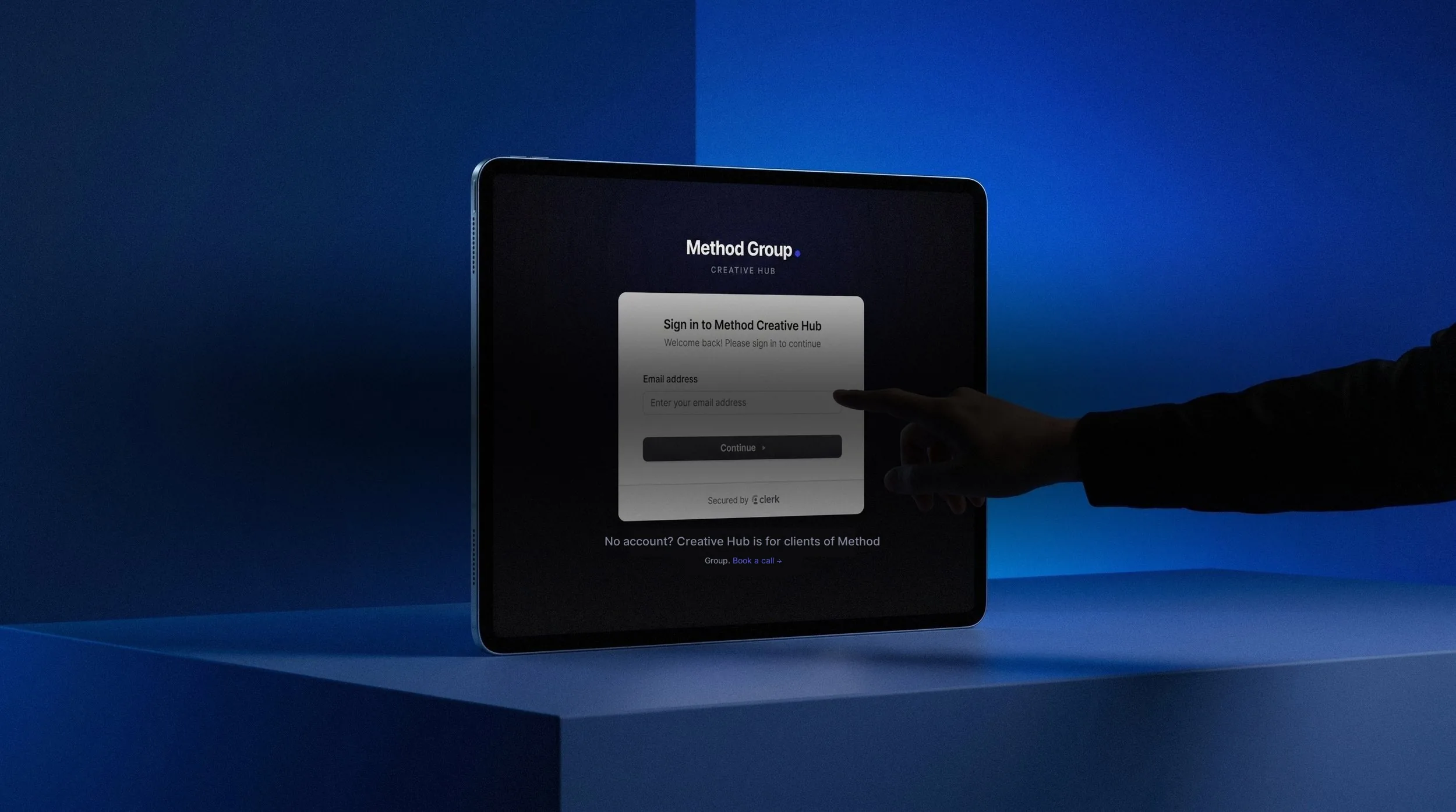
Your projects in one place
See how it works: Method Creative Hub
An output is what you collect when a job ends. A PDF, a render, a landing page, a catalogue, a set of adverts. An asset is something the company can use repeatedly and develop without rebuilding the whole context from scratch.
The difference is easy to test. When the project ends, ask one question: what stays in the company besides the final file? If all that's left is a folder, you have an output. If what's left is a history of decisions, a current version, a process for requesting changes and feedback from sales, you're starting to build a system.
In property development this shows up fast. With one scheme you can still hold in your head what sits where. With several, memory stops being a process. Salesforce reports that sales staff spend 60% of the week on activity other than selling — including manually gluing context together across files and messages. The more work there is around information, the less time there is to talk to a buyer.
Creative Hub and Control Room — two layers of one system
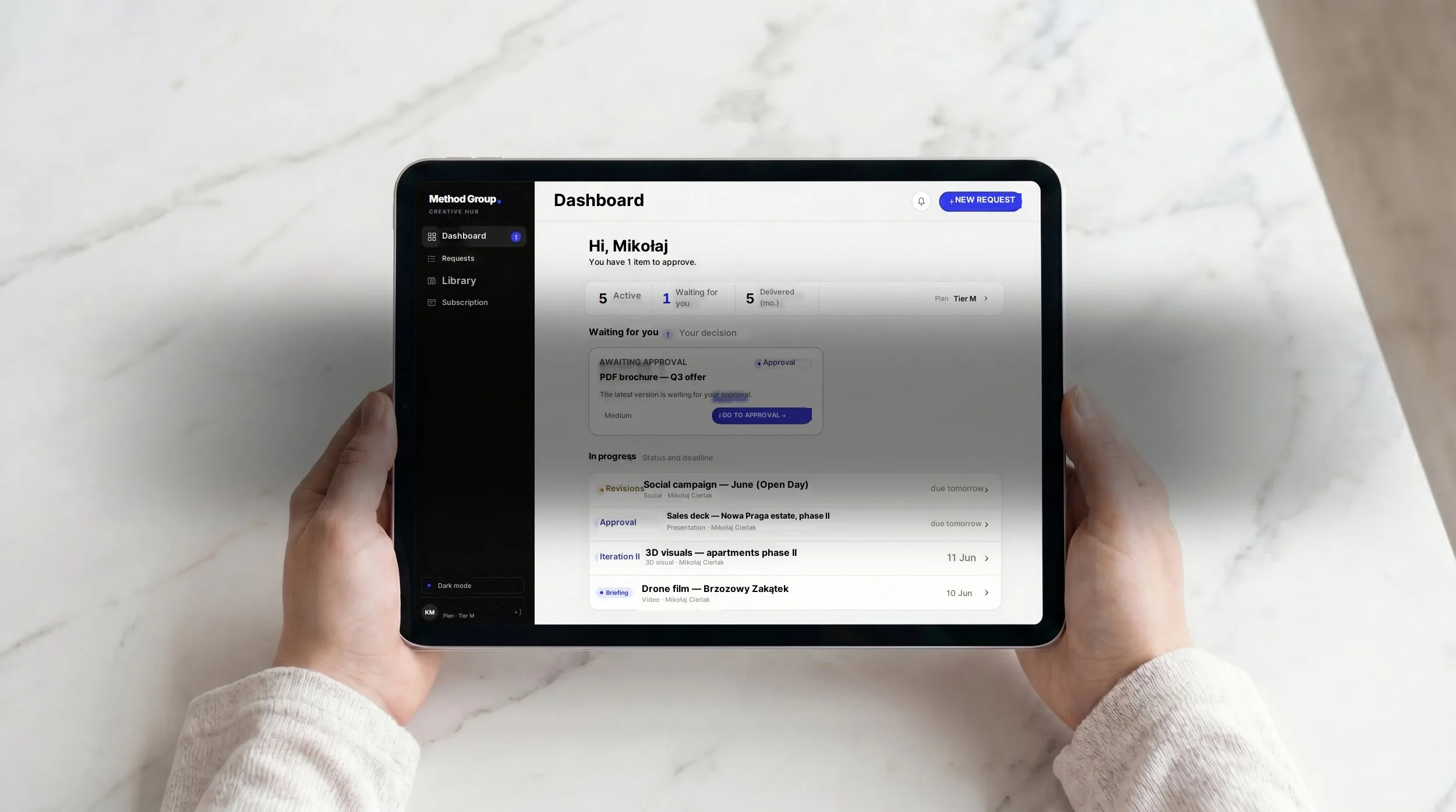
24/7 access for you and your team
See how it works: Method Creative Hub
The client comes in through Creative Hub, that is through a concrete creative need: material, a landing page, a presentation, renders, a catalogue. From the outside it looks like a service. Inside it works as a process from day one.
The brief goes to one place. Jobs have statuses. Material has versions. Decisions don't disappear into private messages. The company stops producing material inside a fresh mess every time.
The second layer appears when the question stops being “do we have the material?” and becomes: does this material actually help sales?
That's Control Room's job: to give marketing, sales and the board the same picture. What's ready, what's missing, which material is current, which objections keep returning, where a decision is needed. Without that loop a company produces more and more without always knowing what is actually working.
The third layer is Care — keeping the system alive. Systems age. Prices, developments, buyers' objections and campaign priorities all change. A system that isn't maintained quickly becomes a better-looking archive.
A test before you buy the next service
Before the next job, five questions are worth asking:
Where will the brief live, and can we come back to it in a month without digging through email?
Where will the team see the status of the work?
Where will the final version live, and who has the right to confirm it?
Where will sales report that the material doesn't answer buyers' questions?
What will be left after delivery, for the next development or campaign variant?
If the answer is “we'll email” or “someone will remember”, you're buying a service that ends in a file. If the answer is one working space and a clear update process, you're starting to build a system.
When you don't need this model
If it's a one-off with a simple scope and you don't plan to come back to it, an ordinary service is enough.
A systems model earns its keep where work recurs. When new material is produced every month. When sales regularly needs updates. When several developments share one logic of communication. When the cost of the chaos exceeds the cost of the production itself.
The worst purchase is the one that sends the company back to the starting line on the next job

A dedicated team from day one
See how it works: Method Creative Hub
A good purchase leaves you material. A better one leaves material and a process. The best leaves a system that, by the next job, knows more about the company than it did at the start.
From the outside the client buys a service. Inside, they start building an operational asset. On the next brief, don't only ask what you'll get at the end. Ask as well: what will be left in the company once the file is done?
See how Method Creative Hub puts material production in order and leaves behind a way of working, not just a folder of files. Book a free call and I'll show you, on your own process, where the output ends and the asset begins.
Usually a folder of files and a few threads scattered across inboxes.
On the next job the team starts almost from scratch: where was the brief, who approved the version, which file is final, what did sales say, why did we change the message last time. On paper the company bought a service. In practice it bought a one-off output.
A system works differently. When a project ends, what remains is a history of decisions, the current version, a process for requesting changes, a list of material, the status of work and feedback from sales. So the next job doesn't start with hunting for context, but from where the company left off.
An output is what you collect when a job ends. A PDF, a render, a landing page, a catalogue, a set of adverts. One-off. It delivers value once and needs the whole context rebuilding whenever something has to change.
An asset is something the company can use repeatedly and develop without starting over. The difference is easy to test. When the project ends, ask one question: what stays in the company besides the final file?
If all that's left is a folder, you have an output. If what's left is a history of decisions, a current version and a clear update process, you're starting to build an asset.
Because nobody keeps it current. The offer changes, prices change, campaign priorities change, buyers' objections change. The material sits in a folder without being updated.
After a few weeks nobody on the team knows whether a piece of material is current or simply the last thing sent. Those are two different things. Sales sends the client a PDF that was current three months ago. Marketing builds a new campaign without knowing what worked last time. The board approves a direction with no picture of what already exists.
A system handles this through Care — regular upkeep of the material. Not a snapshot from launch day, but a working space that grows with the company.
The brief has to go to one place from the first day of the engagement. Not email, not a private message, not a note in a Google Doc only one person can open.
One place means everyone on the team knows where to look, the brief has a change history, decisions are recorded, and you can come back to them a month later without digging through an inbox.
That's the basic difference between a service and a system. A service starts with a brief and ends with a file. A system starts with a brief and keeps it as a living document that tells you next time: this is where we stopped, this is where we changed direction, this is what the client approved.
One place holding the current version of the material, open to the whole team rather than only the person who made it.
In most companies material lives in several places at once. Drive, email, Slack, a local folder on someone's laptop. Sales uses whatever is to hand rather than whatever is current. The result: the buyer gets material that was good a month ago and no longer leads to the right decision.
A system solves it with a single source of truth. There's no question of which file to send, because only one is current. And it's clear who has the right to say a version is final.
By closing the loop between what marketing produces and what sales actually uses and lacks.
Creative Hub puts production in order. Brief, statuses, versions, approvals. But producing material doesn't in itself answer whether that material helps the buyer decide.
That needs a second layer. Control Room shows which material is used in conversations, which objections keep coming back, what sales doesn't have to hand and where a decision is needed. Without that loop a company produces more and more without always knowing what is actually working.
When you're doing a one-off project with a simple scope, one decision-maker, and no plans to come back to the process. An ordinary service is enough. There's no need to force a system around every presentation.
A systems model earns its keep where work recurs. When new material is produced every month. When sales regularly needs updates. When several developments share one logic of communication. When marketing and sales have to see the same picture. When the cost of the chaos exceeds the cost of the production itself.
That's a good filter for any creative engagement. Don't just ask what you'll get at the end. Ask what will be left once the file is done.
An ordinary agency delivers a project and communicates by email, meetings and scattered tools. The project ends with an approval and a file.
Creative Hub works as the place the work lives: the brief goes to one place, jobs have statuses, material has versions, decisions don't disappear into private messages, and the team can see what's in progress and what's been delivered.
The difference isn't only in production quality. It's that after delivery the company has a place where work happens, not just a folder. And that the next job doesn't begin with “where was the last brief?”
Care is maintaining and developing the system after the initial rollout.
Systems age. The offer changes, prices change, buyers' objections and campaign priorities change. Material that was current a month ago may still be sitting in the folder without leading a buyer to the right decision any more.
In the ordinary model a project ends with approval. In a systems model approval is one of the stages. After it, the material's life in the company begins: updates, variants, new sales needs, further formats.
Care keeps the system a place where work happens rather than a souvenir of a rollout. That matters especially in property development, where selling runs for months and everything changes in the meantime.
The fastest test is one question asked before you start: what will be left in the company in three months, when the project is finished and something needs updating?
A project-minded agency will answer with the file, the editable version and handing over the source. A systems-minded agency will answer with the working space, the update process and how sales reports what's missing.
The second signal is how they talk about the brief. If the agency treats it as a one-off form to fill in at the start, it works project by project. If it talks about the brief as a living document returned to at every iteration, it thinks in systems.
The difference also shows in approvals. A project-minded agency closes a stage when the client says “OK”. A systems-minded one has a single place showing who approved what and when — with no reconstructing the history from emails.