2026-03-22 · Blog
What is Creative-as-a-Service? The model that replaces recruitment
Details
An in-house designer isn't just a salary. Add recruitment, onboarding, employer contributions, software and the risk of burnout. Here's what a creative headcount really costs and when it stops paying off.

“CaaS”, or “Creative-as-a-Service”.
An end to formalities, the start of production
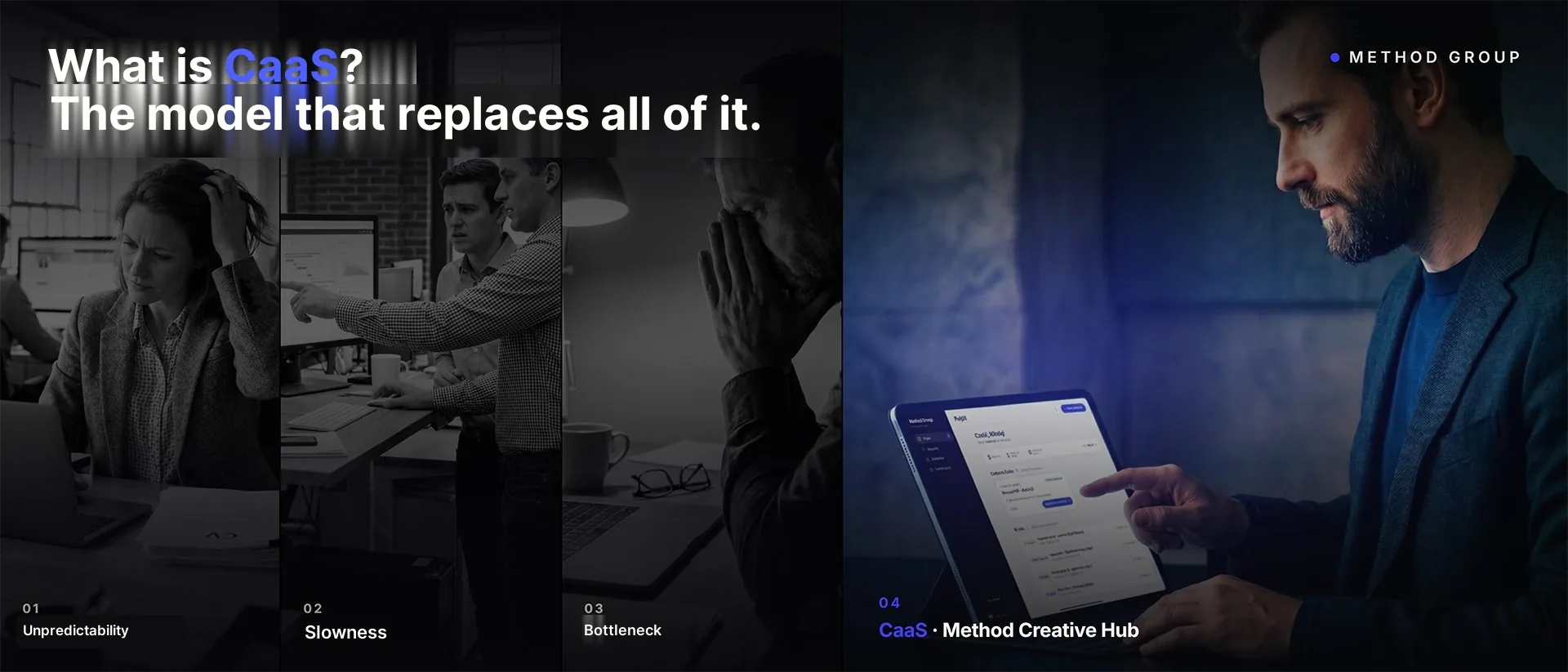
Your company needs material. You have a brief, a budget and a strategy. What you don't have is time for a three-month recruitment, six months of onboarding and the discovery a year later that the person you hired can't cover half of what you need.
There's a model that solves this. Internationally it's used by companies like Meta, Amazon and Shopify. In Poland almost nobody talks about it yet — which means the companies that adopt it first gain an advantage the competition won't quickly close.
It's called Creative-as-a-Service. And it isn't what you think.
What CaaS is — the definition that matters
Creative-as-a-Service isn't a subscription to a designer. It isn't a block of hours at a local studio. It isn't a freelancer available Monday to Friday, nine to five.
According to Method Creative-as-a-Service is cutting out unnecessary formalities in favour of the time it takes to make the creative work companies need in order to grow.
In practice it means one thing: you pay a single subscription and produce what you need — no limits on specialism, no renegotiation for every new format, no explaining the brief again to four different suppliers. The system adapts to your company and grows with it.
That's a fundamental difference from everything that has passed for “creative outsourcing” in Poland so far.
Why this model is growing globally by the billion
CaaS isn't a local experiment. It's a documented global market trend with hard numbers behind it.
The creative services market was valued at $14.4bn in 2024 and is forecast to reach $25bn by 2035. Where does that growth come from? Over 80% of marketing leaders worldwide report far more demand for creative production than their teams can handle.
Almost 90% of companies use video in their marketing — but high-quality video has traditionally taken weeks to produce. One documented case cut video production from three weeks to five days after moving to CaaS.
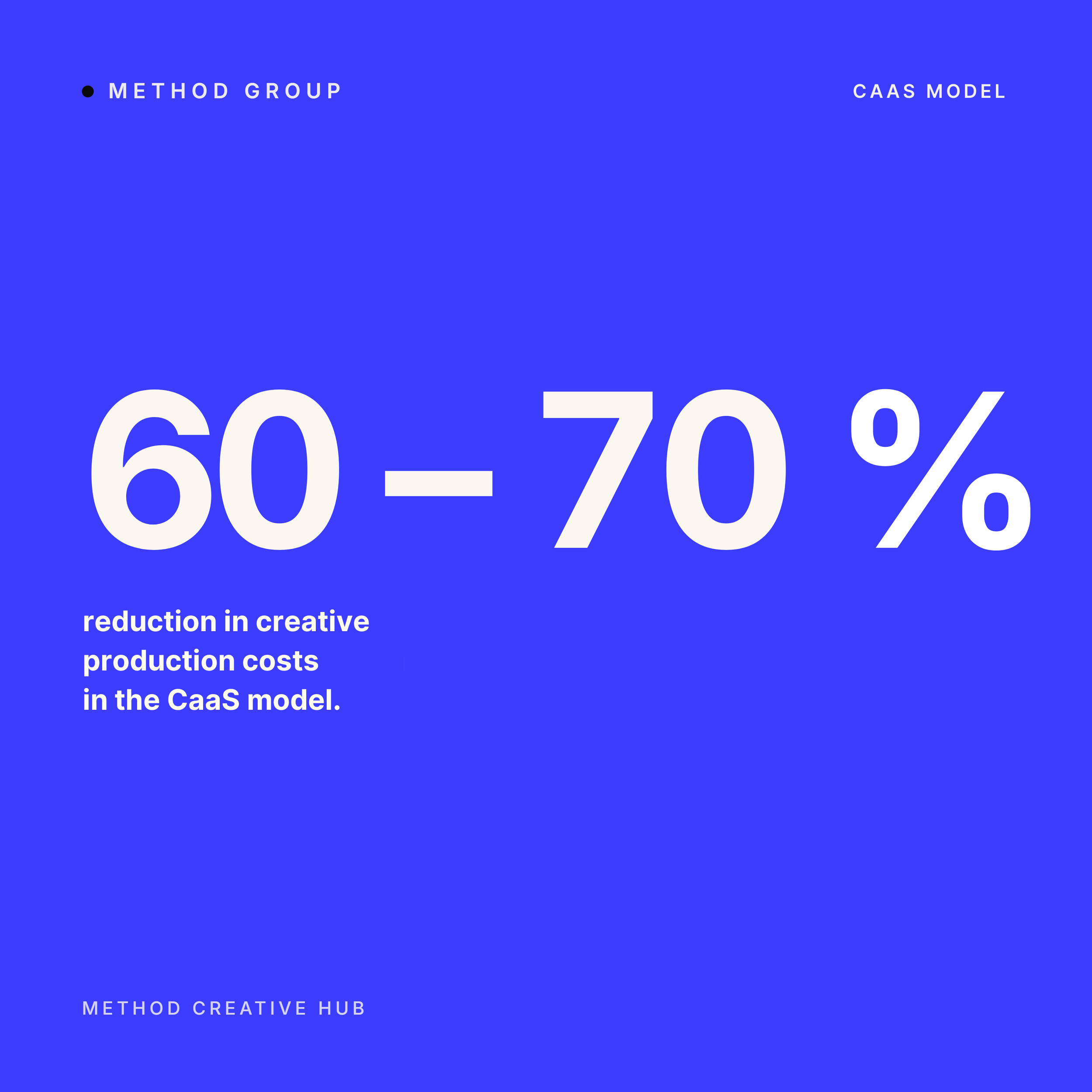
Companies using the model report a 60–70% reduction in creative production costs compared with traditional agencies, and a 15–30% improvement in ROAS. These aren't marketing promises. They come from research by TrinityP3 and McKinsey.
What the alternative really costs — the hard numbers
Before settling on CaaS, a company usually considers hiring a senior creative in-house. It's worth doing the sums honestly.
A senior graphic designer or art director in Poland now earns 10,000–15,000 PLN gross a month. On top come employer costs — social security adds another 20%. A headhunter's fee at this level is 12,000–24,000 PLN one-off. Finding the right person takes three to six months. Onboarding takes another three before they understand the brand and work independently. Then software, training and equipment.
The real first-year cost of employing a senior creative in Poland looks like this:
And that assumes the hire works out first time. That the person doesn't leave after a year. That one person covers the whole range — CGI, motion design, UI/UX, branding, video, AI — that your company needs at once. None of those assumptions is safe.
Method Creative Hub starts at 10,000 PLN a month on tier-S — 120,000 PLN a year. No recruitment. No onboarding. No risk. With the full range of skills from day one and a 48-hour SLA on first material.
The argument is simple: CaaS is cheaper, faster and safer than a headcount. Not as an opinion — as arithmetic.
Who CaaS makes sense for — and who it doesn't
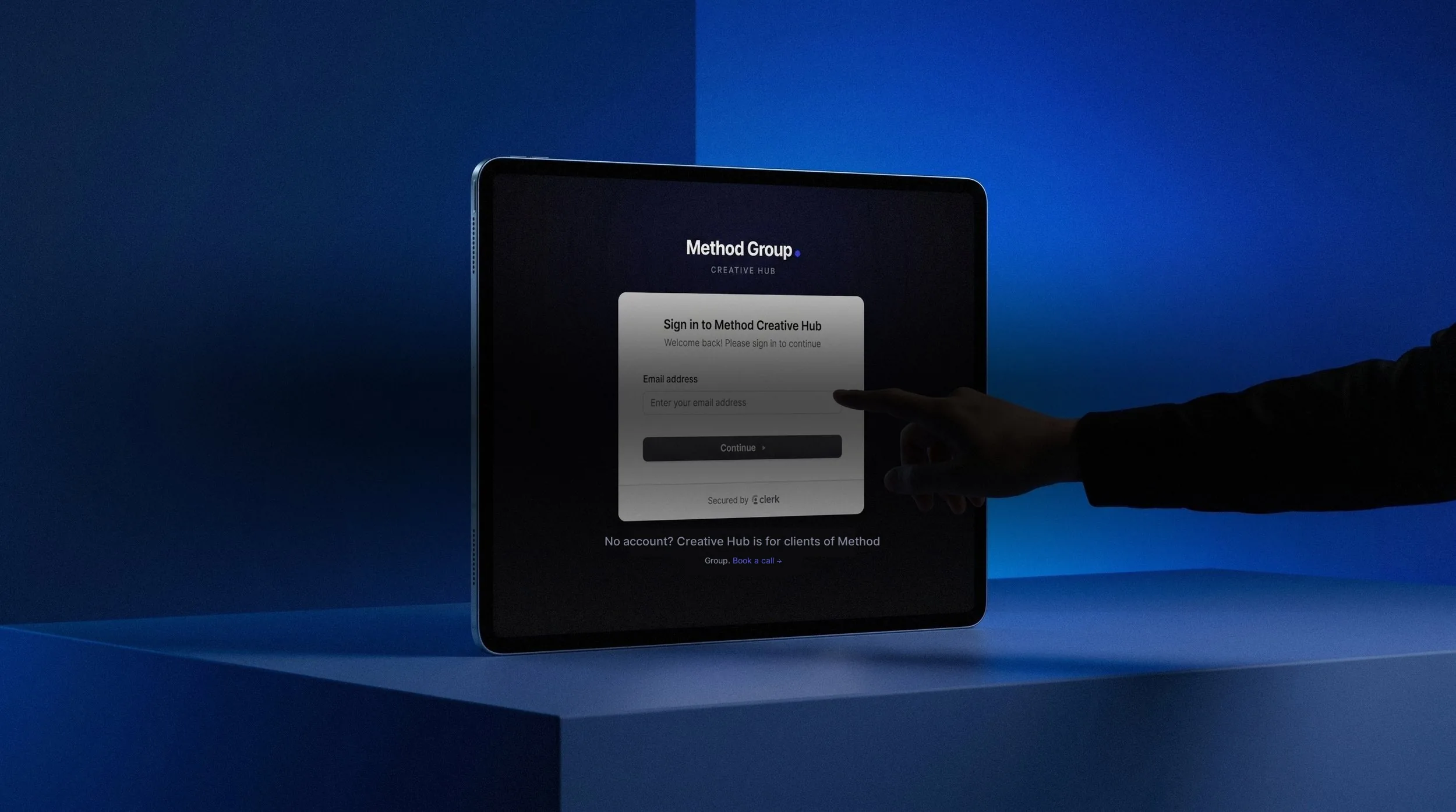
Your projects in one place
See how it works: Method Creative Hub
CaaS isn't for everyone. The honest answer is this:
If you have a well-developed in-house creative department that produces everything on time, consistently and in line with the brand — you don't need CaaS. Congratulations, you're in the minority.
CaaS makes sense for companies facing specific problems: the list of creative work grows faster than the team's capacity; material from different suppliers looks as though it came from different companies; hiring another person doesn't solve it because nobody has time to lead them; or the company is growing and needs to scale production without scaling headcount.
If you recognise even one of those, the model is for you.
Where the quality comes from — the ecosystem behind Method
Most CaaS providers worldwide operate the same way: a platform connects clients with a pool of freelancers. The client sends a brief, someone from the pool picks it up and delivers.
Method works differently, and there's a concrete reason for the difference. Method Group grew out of three brands with established positions in the Polish creative market.
VizAcademy — one of the largest training platforms for 3D and AI specialists in Poland. Thousands of designers, visualisers and digital creators have come through its programmes. This isn't an HR resource — it's a map of the best talent on the Polish market. We know who can genuinely do the work, because we've assessed it in practice, not just in an interview.
VizMaker — a 3D and AI visualisation tool that knows the realities of production from the technology side. Not as theory, but as the daily practice of thousands of users.
Pixelcraft Agency — a creative production studio that treats execution as a craft, not a side service.
No foreign competitor can say anything comparable about the Polish market. Method has something else: deep knowledge of the local creative ecosystem and direct access to the best specialists in Poland.
What it looks like in practice — the “aha” moment
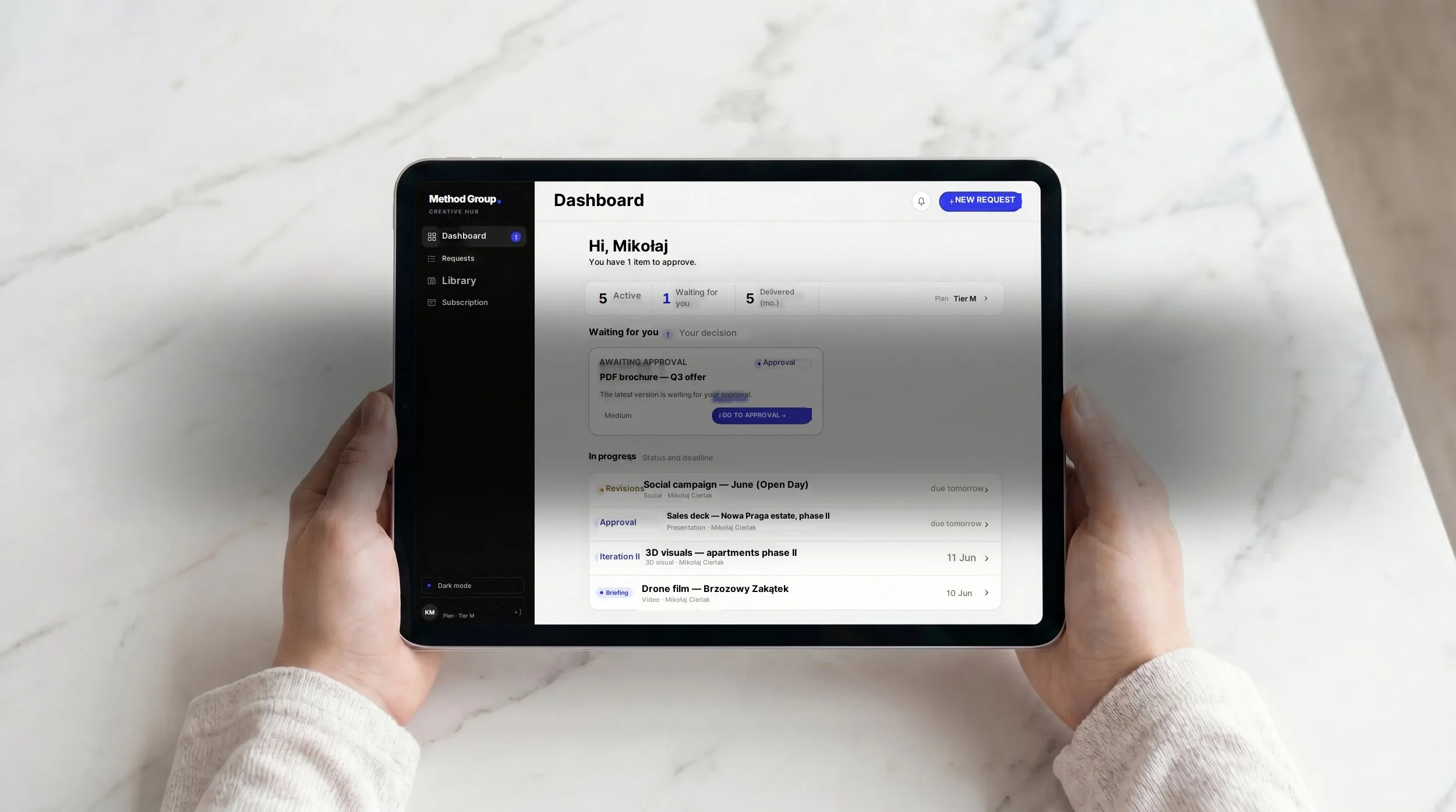
Round-the-clock access for you and your team
See how it works: Method Creative Hub
In conversations with companies weighing up The Creative Hub model, the same turning point always comes. The client asks: “But what exactly can we order?”
The answer: everything your company needs producing — CGI, motion design, UI/UX, branding, video, animation, AI, 3D renders, landing pages, B2B presentations, ad creative, material for distributors, influencer packs, 360° tours. All on one subscription, with no separate quote per format and no re-explaining the brief for every job.
And then comes the line: “So it's like having my own creative department, except I don't have to build it?”
Exactly that.
CaaS, not just design — why the name matters
One thing worth clearing up, because it comes up often.
Design-as-a-Service (DaaS) and Creative-as-a-Service (CaaS) are not the same thing. DaaS suggests graphics, UI/UX, visual design. It describes a slice. CaaS describes the whole ecosystem of creative production — from visual strategy through CGI and motion to a finished campaign asset.
Which is why Method uses the term CaaS rather than DaaS. Because what we deliver isn't a piece of design. It's an operating system for your company's creative production.
What next — how to tell whether CaaS is right for you

A dedicated team from day one
See how it works: Method Creative Hub
The easiest test:
Count how much time you or your team spent last month coordinating suppliers instead of on strategy.
Count how many briefs have been waiting more than two weeks.
Count how much material of your brand's looks inconsistent across channels.
If any of those is greater than zero, it's worth a conversation.
Method Creative Hub — a free walkthrough, with first material within 48 hours of signing.
Creative-as-a-Service is subscription access to a full creative team for a fixed monthly fee. Instead of recruiting, onboarding and managing, you have a ready-made external creative department from day one.
One subscription gives you CGI, motion design, UI/UX, branding, video and AI at the same time. Production starts within 48 hours, with no limits on specialism and no re-explaining the brief for every job.
An in-house designer means one specialism, a fixed cost even when there's no work, and three to six months before they operate independently. CaaS gives you the full range from day one, a predictable monthly cost and a 48-hour SLA on first material.
The choice depends on scale — if you need one person for one repetitive job, a headcount may do. If your list of creative work spans more than one specialism and grows faster than your capacity, CaaS wins on the arithmetic.
The real first-year cost is around 244,000 PLN — counting gross pay, employer contributions, recruitment, software and training. Effectively about 20,000 PLN a month, and for the first three to six months without full output.
Method Creative Hub starts at 10,000 PLN a month on Tier-S — 120,000 PLN a year — with no recruitment, no onboarding and no risk of a hire that doesn't work out.
It comes down to one question: how broad your needs are and how predictable the volume is. A headcount works when the scope is narrow and repetitive and you have time to onboard.
Creative outsourcing under CaaS works when you need several specialisms at once, delivery on time and the ability to scale without renegotiating contracts. Over 80% of marketing leaders report more demand for production than their teams can handle — a sign that a headcount on its own doesn't solve the structural problem.
Through a subscription model that grows with the company. Instead of hiring someone new for every new need, you widen the scope of the subscription. Companies using CaaS report production costs down 60–70% against a traditional agency and ROAS up 15–30%. One documented case cut video production from three weeks to five days after the switch.
It's a fixed monthly cost for access to a full creative team — much like a software subscription, except that instead of a tool you get people and production. No per-project quotes, no contract addenda when the scope changes, no re-explaining the brief.
At Method Creative Hub one subscription covers CGI, motion, UI/UX, branding, video, AI and 3D renders — all in one place with one point of contact.
You send a brief and get material within 48 hours. No recruitment, no onboarding, no team to manage — that sits with the supplier. In practice it looks like your own creative department, except you don't have to build it.
Method works differently from most global CaaS platforms — instead of matching clients with a random freelancer from a pool, it supplies a vetted team from the ecosystem of VizAcademy, VizMaker i Pixelcraft Agency.
The chaos usually comes from having no single point of responsibility — every supplier has their own brief, their own deadline and their own style. The material looks as though it came from different companies. CaaS solves it by centralising: one subscription, one team, one workflow. Instead of coordinating four freelancers yourself, you get a system that does it for you.
When the cost, time and risk of recruiting outweigh the cost of a subscription. Hiring a senior creative in Poland takes three to six months and costs over 244,000 PLN in the first year — before you know whether the decision was right. CaaS removes that risk: you start within 48 hours, the cost is fixed and predictable, and if the scope changes the subscription adapts without renegotiation. It's the right call when the company is growing and needs production that grows with it.