2026-08-28 · Blog
You hired a marketer and got a supplier coordinator. How to reverse that.
Details
Renders, animation, development websites, catalogues and unit sheets from one supplier, in one place. What we do, what working with us looks like and what it costs.

We make marketing and sales material for premium residential developers and premium building-materials manufacturers. Renders, animation, 360° views, development websites, 3D models, catalogues, unit sheets, campaigns and copy.
The whole set is made in one place, so the render for the bank, the development website and the unit sheet come out with one character and under one quality standard. You aren't collecting quotes for every format or explaining to a fourth supplier what the first one agreed.
We run the engagement through our panel. You order in it, see statuses and dates, leave comments, approve, and the files stay in place with a version and a date. No email threads and no links that expire after a week.
The result: your marketing team stops herding suppliers and goes back to commissioning and approving. Material for a sales launch or a collection launch is ready before the date, not during it.
Where your marketing team's time goes
Renders in Poland are good and easy to buy. The problem starts a level above that.
One studio does the renders. An agency does the development website. Someone else does the brochure. A fourth company does the 3D model. Each works at their own pace, in their own style, in their own email thread. In the middle stands one person from marketing gluing it all together — and the gluing eats a month that was meant for the campaign.
You hired them for what they know. They understand the market, they can run a campaign, they know what sales needs. A few months in, they are effectively managing suppliers: chasing deadlines, chasing revisions, explaining to one company what another has agreed, and making sure the brochure looks like the website and the website looks like the animation. They do it well. It just isn't what you hired them for.
The second thing happens to the material itself. The render studio has its own palette, the web agency its own grid, and whoever made the brochure was emailed a logo and picked the rest themselves. Separately, each piece looks fine. Together, laid out on the client's table, you can see four different companies. A buyer won't put a name to it, but the difference between a brand that is run and a brand that is glued together shows in the first few seconds.
You pay for it twice. Once in days nobody invoices, because every decision waits on an answer from another company. And again in a salary for skills you're using at half capacity. We broke down what that headcount really costs in our piece on the cost of an in-house designer.
Work out for yourself how much of your team's time goes on coordination alone. Which render is current, the one on the drive or the one in the last email. Who was supposed to fix the unit sheet. When the trade-show brochure will be ready. On top of that the invoices arrive irregularly, and with every extra revision somebody negotiates what's still in scope.
It ends with marketing becoming the bottleneck. Material is ready at the last minute or after the launch, and sales is left waiting.
What exactly we produce
The first layer is production — the things made to your order.
- CGI, 360° renders, architectural and product animation
- 3D models, apartment finders and development websites
- catalogues, product sheets, unit sheets, sales brochures
- communications strategy, key visual, naming, campaign creative
The second layer is running things — what happens over time and needs someone keeping an eye on it.
- press distribution to editors, with a register of coverage in the panel
- social media, with a calendar and post approvals in the panel
- articles, copy and managing published coverage
- ad campaigns where you don't have a media agency of your own
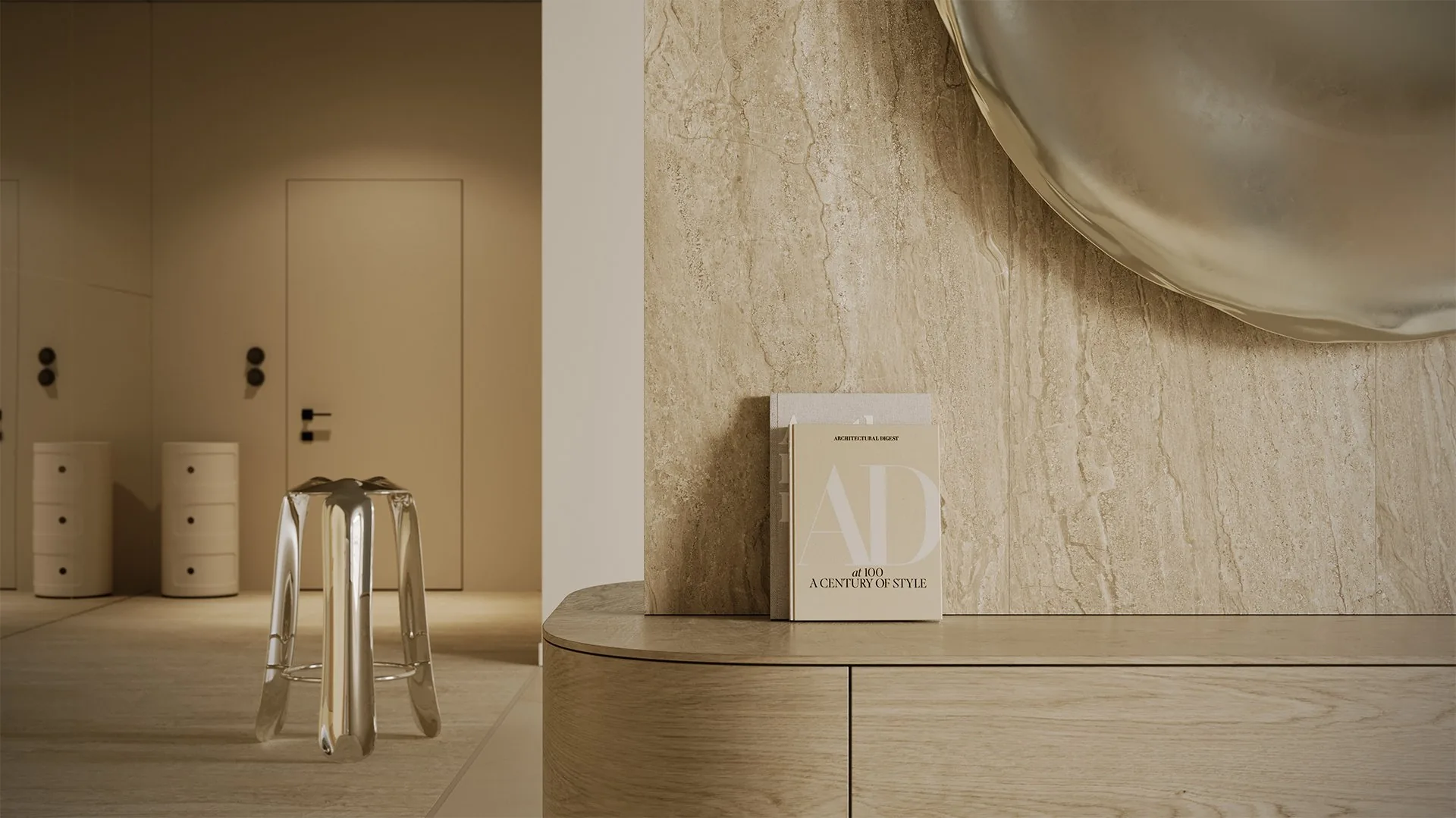
You stop collecting quotes for every new format. You have one catalogue of items, one contract and a team that knows your brand because it did the last launch. A collection launch or a sales launch stops requiring three hires and five quotes.
What working through the panel looks like
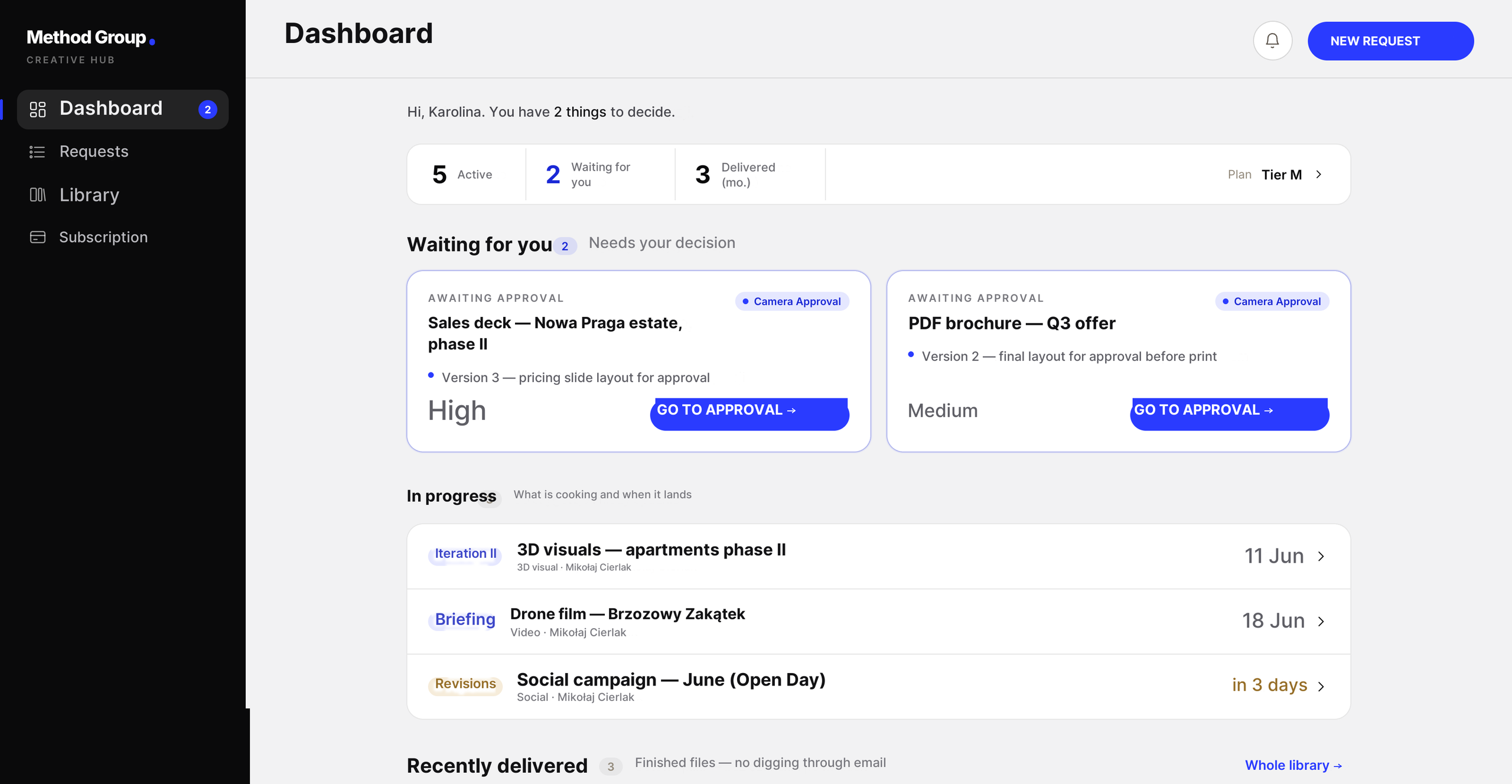
The panel is called Method Creative Hub. You get it because you work with us. We don't sell software, so there's no licence and no per-user fee.
Every client gets the same fixed core:
| Area | What it gives you |
|---|---|
| Dashboard | what's waiting on your decision, what's in progress, what's been delivered |
| Projects | ordering, statuses, deadlines, notes and conversation attached to a specific project |
| Board | comments and approval of visual material without leaving for another tool |
| Drive | an archive of everything plus a working space per project; every file has a version and a date |
| Invoices and subscription | allowance, usage, billing |
| Messages | general conversation, outside individual projects |
| Knowledge base | material on how to use it |
On top of that come modules switched on when the scope calls for them. A publishing calendar with social media, a register of coverage and distribution reports with PR, campaign data with advertising. We don't switch on tabs we have nothing to fill, because an empty library and “0 active projects” make a worse impression than not having them at all.
The effect shows up fastest in file versions. Today the current version lives in one person's inbox, and every copy sent out starts ageing from that moment. In the panel an agent takes the current unit sheet without asking anyone, and a distributor stops sending a two-year-old catalogue just because that's what happened to be on their drive. Each of these looks like a triviality on its own, which is why nobody reports them. Added up, they come to a month of work and several sales conversations that went worse than they should have.
Access is free for any number of people on your side: marketing, sales, the board, the board's assistant, whoever handles the product. We don't charge per head, because you're paying us for the work and the panel is how it's delivered.
What it costs
Two routes, depending on whether you need material continuously or for one event.
Subscription. A fixed monthly production allowance: S 13,500 PLN, M 19,500 PLN, L 26,000 PLN, XL from 38,000 PLN a month. Every item in the catalogue has a value set in advance, so you know what a job costs before you approve it. Unused allowance rolls over into later cycles, so a slower month doesn't go to waste.
Per project. The same items at a rate half again as high, the panel for the duration of the project and a window to collect the files once it ends. Sensible if you're doing one development or one launch and don't want an ongoing commitment.
You don't pay separately for access to the panel, for extra users, or for further formats cut from the same material. From one shot come versions for a billboard, the website, social media and the bank presentation, with none of them negotiated individually.
If you're weighing this against a hire or a conventional agency, two pieces take the maths apart: what Creative-as-a-Service is i what an in-house designer really costs.
What it looks like in practice
Stargres, a porcelain stoneware manufacturer. One of the widest launches in the brand's history, 13 collections at once. Instead of a set of renders, we built one visual system for every channel, delivered continuously over six months against launch and trade-show dates.
A manufacturer putting out a dozen or more collections in a season won't hold consistency across several suppliers, because none of them sees the whole. Full scope and how it ran: the Stargres case study.
Soho Residence, Terra Casa. An apartment finder wired into the developer's system. The listing updates itself, so nobody edits statuses on the site by hand after every reservation. Under the price transparency rules this class of error is the costliest: the price on the site drifts from the price in the system, and the liability sits with the developer.
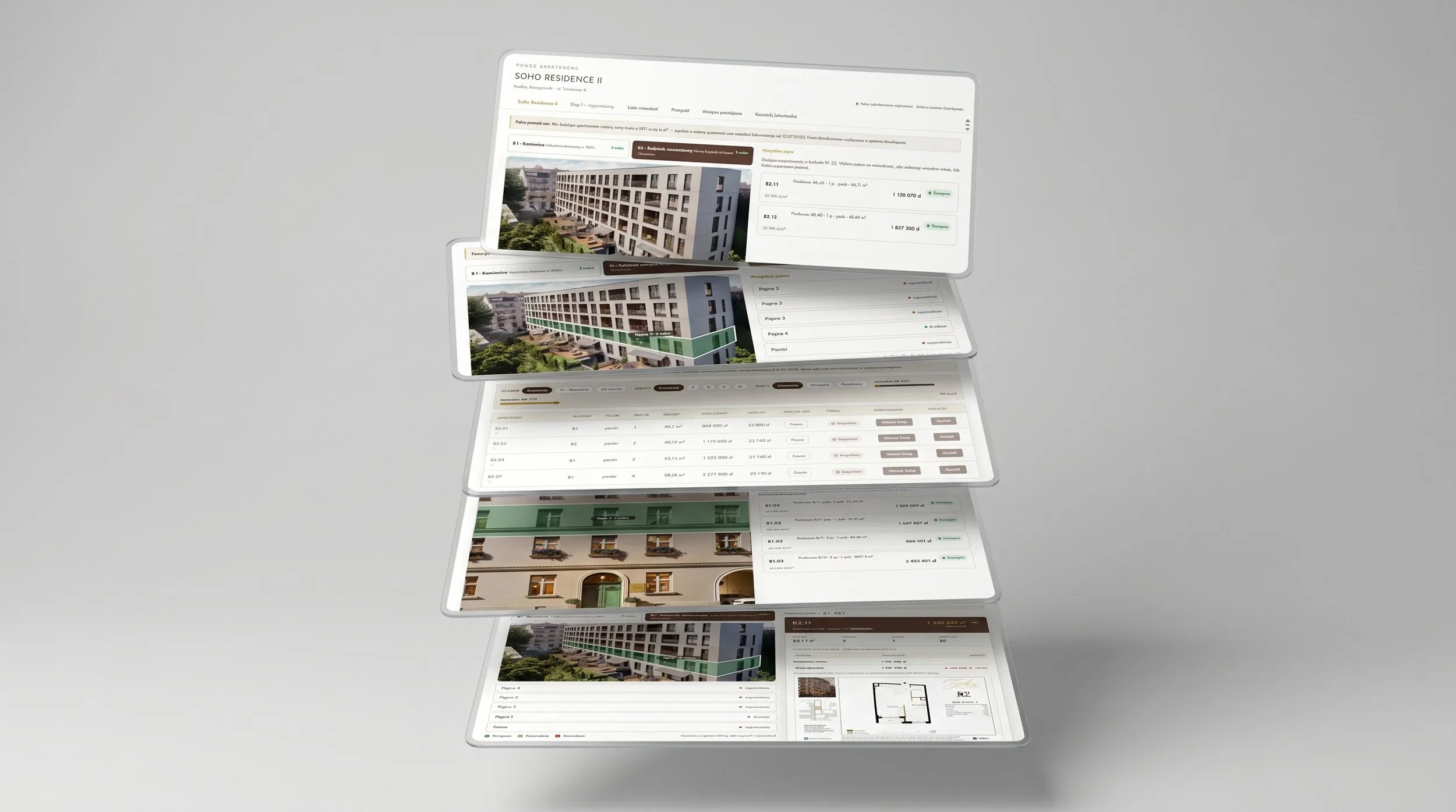
Art Deco Mokotów, Terra Casa. The full set from one set of branding: renders, 360° views, a website and an interactive 3D model. One partner for all of it instead of four contracts and four readings of the same project.

See the panel from the inside before you sign anything
Thirty minutes on a live account. We show you ordering, approvals and the file library, and convert a typical month of yours into specific catalogue items.
Book a free demoWhat happens when everything shares one date
Before a trade show or a sales launch, material doesn't arrive in sequence. The renders, the website, the brochure and the unit sheets all share a deadline, and every day of slippage moves the campaign.
We have the production capacity for that peak in-house and don't go out and find a subcontractor. Which is why the last batch looks like the first, rather than like the work of someone who joined halfway through and was emailed a logo. On the Stargres launch that meant 672 renders in one visual system, delivered over six months against a run of dates.
See the whole set before you order anything
The model is the same in both cases. What differs is the vocabulary and the calendar.
A developer bringing a scheme to market needs the whole set for one date: renders for investors, animation for the sales campaign, a website, a model or a finder, unit sheets and brochures. If you want to see exactly what we deliver, and to what standard, before ordering anything, look at Method for developers. From renders through branding to a development model you can click through exactly as your buyer will.
Manufacturers work to a different rhythm, set by collection launches and the trade-show season, and the material has to reach not only the end customer but the distributor, the architect and the contractor. If you want to see what a full set for a collection launch looks like — from room sets and packshots to a film for the stand — and how much comes out of one scene with no shoot day, look at Method for manufacturers.
When Method doesn't make sense
You have a large in-house team that delivers everything on time and in one character. You don't need us permanently. Get in touch at the peaks, when your own team can't keep up. That's what project billing is for.
You need one render once a year. A subscription makes no sense then and we'll say so. Take it as a one-off job.
You're after the lowest hourly rate. That's a different conversation. We sell predictability and premium-level production; the cheapest hour isn't on offer here.
You want the panel to replace a CRM or ERP. It won't, and we don't try. Prices, statuses and sales data stay in your system. We connect to it read-only, as with Soho Residence, and make sure what the buyer sees matches the source.
How to check this in your own company
Before anyone puts a quote in front of you, check whether you have this problem at all. Three things, each takes a few minutes and needs nobody's permission.
Search your inbox for the name of your latest development or collection. Count the companies you exchanged emails with about it over the last month. Three or more means somebody at your end is working as a link between suppliers, just without it being in their job description.
Ask two people in the company to send you the latest version of the same brochure or unit sheet. Compare the files. If they differ in date, in version or in anything at all, that isn't one person's slip. It's the absence of a place where the current version is obvious.
Ask an agent where they get the current price and unit sheet before a conversation with a buyer. An answer that starts with “I'll email…” or “I'll ask…” means that at every conversation sales is waiting on marketing.
None of them set off an alarm? Then you have this in order and a shared place won't add much. Two or three did? That isn't about how one person organises their work, it's about the model you're working in. This test costs nothing and answers the question better than any presentation.
What next
Thirty minutes. We show you the panel from the inside on a live account, convert a typical month of yours into specific catalogue items, and tell you straight whether the model makes sense for you.
If it doesn't, we'll say so in that conversation. It's in our interest to. A client who takes a subscription with nothing to fill it leaves after a quarter and both sides have wasted time.
Frequently asked questions
Producing marketing and sales material for premium residential developers and premium building-materials manufacturers. CGI, animation, 360° renders, 3D models, apartment finders and development websites, catalogues, product sheets and unit sheets, brochures, key visuals and campaign creative. On top of that, the ongoing work: press distribution, social media, managing published coverage and ad campaigns. All of it runs through one panel, Method Creative Hub.
In scope and in how the work is run. Instead of four suppliers for a complete set, it's all made in one place under one quality standard, so the render, the website and the brochure speak the same language. The work happens in the panel: you order, you see statuses and dates, you leave comments, you approve, and the files stay in place with a version and a date. Which means the company has one place where it's obvious which version is current and who approved it.
Two routes. A subscription with a monthly production allowance: S 13,500 PLN, M 19,500 PLN, L 26,000 PLN, XL from 38,000 PLN a month, with any unused allowance rolling over into later cycles. Or project billing: the same items at a rate half again as high, the panel for the duration of the project and a window to collect the files. Every item in the catalogue has a value set in advance, so you know what a job costs before it starts.
No. There's no licence and no per-user fee, and access is free for any number of people on the client side: marketing, sales, the board. The panel is how we deliver the work; we don't sell it separately.
No, and we don't try to. Prices, statuses and sales data stay in your system, because that's what knows who's buying. We connect to it read-only where that makes sense, as with the Soho Residence apartment finder, and make sure what the buyer sees on the site matches the source.
Yes. Project billing exists precisely so you can do one development or one launch without an ongoing commitment. You get the panel for the duration of the project and a window to collect the files afterwards. If you need material once a year, we'll advise against the subscription ourselves.
That's what most of our projects look like: a sales launch or a collection launch pulls renders, website, brochure and unit sheets onto a single deadline. We have the capacity for that peak in-house, so we don't go out and find a subcontractor, and the last batch looks like the first. On the Stargres launch that meant 672 renders in one visual system, delivered over six months against a run of dates.
For companies with a large in-house team that delivers everything on time and in one character. For anyone who needs a single render once a year. For companies chasing the lowest hourly rate, because what we sell is predictability and premium-level production. And for anyone expecting the panel to replace their ERP or CRM.