2026-05-03 · Blog
Why you keep rolling out tools and the chaos stays — and how to build a system that learns your company
Details
The company bought a system, ran the training, and people went back to Excel anyway. It isn't their fault. It's an empty context. Here's why a tool that knows nothing about your company won't replace a system.

A system that learns your company. Not the other way round.
Companies roll out tools and go back to Excel — not because the tool is bad, but because it was given an empty context. A real system requires no adaptation, because it's built around how the company already works.
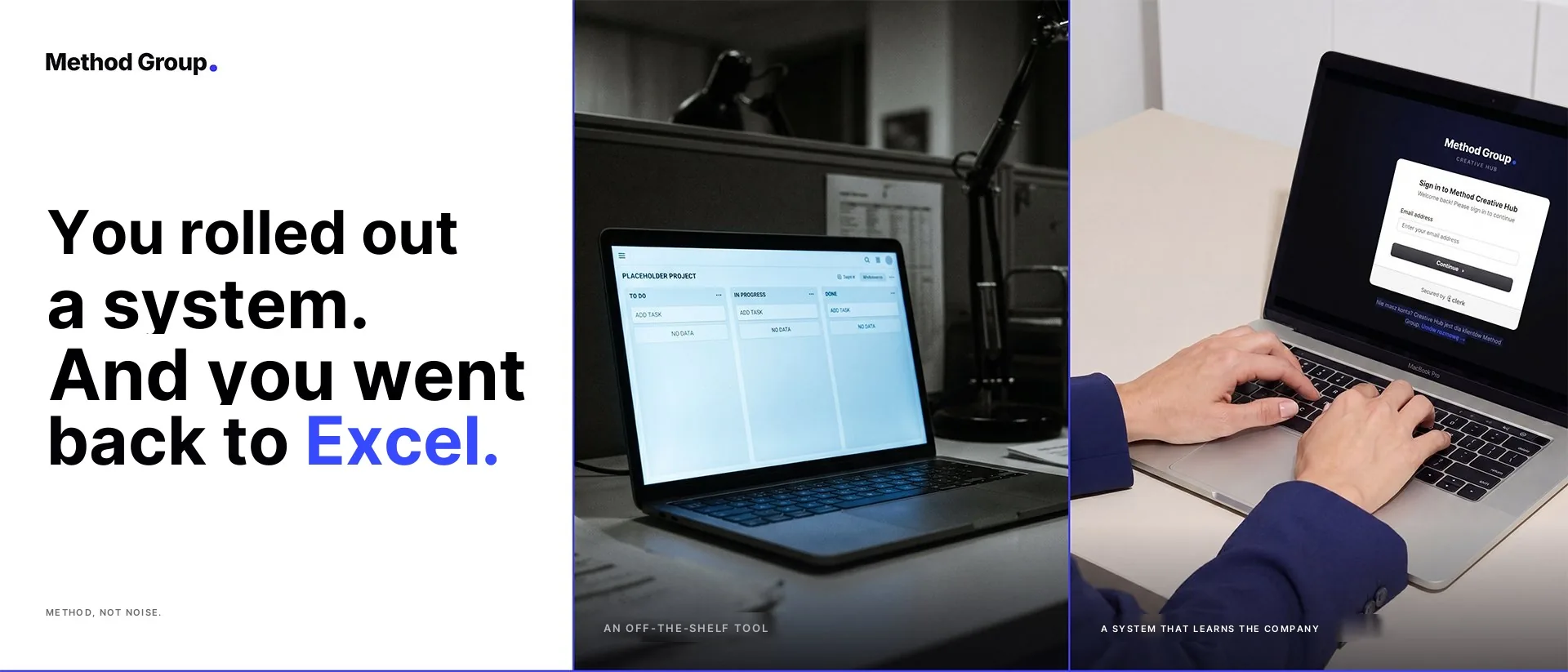
Most companies try to fit their process to the tool. Which is why after two weeks they're back to Excel, email and questions on Slack. Not because the tool is poor. Because it was given an empty context.
This is the commonest mistake I see in conversations about systems and automation. A company wants to roll out a system but can't show where knowledge lives. The material is on Drive. Feedback and statuses are in messages. Decisions are in the owner's head. Sales is in separate notes. And now we're adding a new tool to that.
The result is predictable. For a moment it's impressive, because software looks like order. Then comes the first hard question: is this current? And the system falls apart. Because it doesn't know which presentation is the latest. It doesn't know the board's last decision. It doesn't know which sales argument works and which was just an idea in a meeting.
A tool with no context about the company is like a capable intern who hasn't been to any of the meetings. It can help. It won't run the work.
What I actually saw from the inside
Over the last few years I've gone into companies as an operator. Sometimes as COO for a longer stretch, sometimes to build one specific system from scratch. Every time the same thing: the company was growing faster than its own way of holding itself together.
At Pixelcraft, in a phase of fast growth, I found the work split across five tools. A client enquiry waited around two days for a reply. Projects fell between email and chat. Nobody knew for certain who was doing what. The classic answer would have been: let's roll out a big project management system and learn it.
I did the opposite. I built one place around how the team already worked: it catches every enquiry and assigns it immediately, and prompts when something has been sitting too long.
The effect: visibility of the work rose from around 30% to 95%. Response time fell from two days to four hours. Five tools became one. The team grew from nine to twenty-four people without losing control.
Not because people finally learned the system. Because the system did what they were doing anyway — without losing work along the way.
It wasn't a question of training. It was a question of direction
There are two ways to build a system.
Either the company adapts to the tool — and people fill in fields that make sense to software rather than to their day. At the first bit of pressure they go back to Excel. Or the tool adapts to the company — and there's nothing to adopt, because it simply fits.
The industry knows where the first route leads. McKinsey's “The state of AI in 2025” reports that 88% of organisations regularly use AI in at least one function, but only around a third have begun scaling it organisation-wide, and 39% report any impact on EBIT.
MIT NANDA's report “The GenAI Divide” goes further: after analysing over 300 initiatives it finds that 95% of the organisations in the sample got no measurable return from GenAI. The reason isn't technical. It's fragile ways of working and no place for the tool to learn from.
The quickest proof of how it looks the other way round
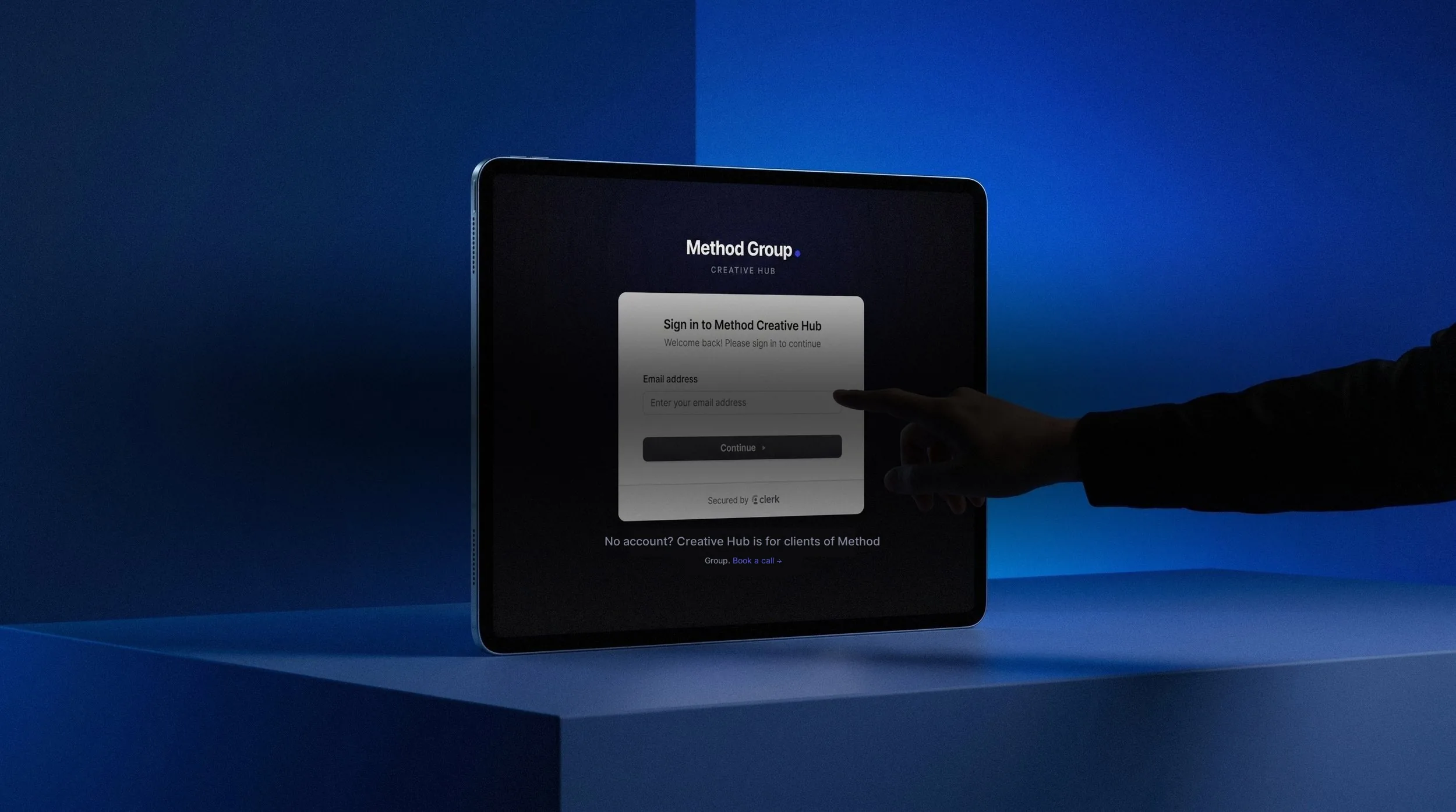
Your projects in one place
See how it works: Method Creative Hub
Local Investments — a developer with four schemes — was running 65 apartments in Excel. Leads from forms landed in an inbox, prices were updated by hand, and the history of price changes existed mainly in good intentions.
I didn't push an off-the-shelf developer CRM on them that would have meant rebuilding their whole sales process. I built a database of every unit as a single source, a form that goes straight where it needs to and replies to the buyer itself, and a listings widget that updates prices on the site by itself — along with a price history that now maintains itself.
A working system was up in a day. No leads lost, and the listing always matching reality.
That one landed at the right moment. Since 11 July 2025 the housing price transparency act has required developers to publish prices and their history. A company that kept this in Excel suddenly has a legal obligation. A system built around that company meets the obligation on its own. An off-the-shelf tool would first have to be adapted to the new rules.
I saw the same at a training company, where several hundred leads a month landed in one heap until a system began prioritising them the way their best person would. And at an interiors studio, where a booking system costing 400 PLN a month was replaced by something simpler, matched to how they worked, for nothing.
My mistake: I used to start with a tool too
The first time I built operating systems I had the same instinct. A new tool gives you a quick sense of progress. There's a login, a dashboard, a few automations. For a while it feels as though the company is more in order.
But a tool doesn't fix a process. It exposes it.
At PXCA the problem wasn't that another CRM was missing. There was a CRM — it formally existed, only nobody actually worked in it. Had I said at that point “let's add AI”, I'd have got a more expensive version of the chaos.
The work had to be mapped first. Where does a lead land? Who decides? Which status means we can act and which means we're waiting? Only then did building a system make sense.
What it means for a system to learn
This isn't about a system getting to know a brand in some soft, magical way. A system learns a company when every piece of work leaves behind a useful trace.
A brief isn't only a description of a task. It's information about how a client thinks about their development, their product and their sales goal. Feedback isn't only a revision. It's a decision about what the brand doesn't want and where its limits of quality lie. An asset isn't only a file. It's the current version marketing or sales can use.
If those things stay in email, the system learns nothing. Individual people learn. The designer remembers the client dislikes a particular composition. The project manager remembers who approves the final version. The salesperson remembers a particular objection keeps coming back.
The problem appears when one of those people isn't available.
The company runs on questions again: who knows this, where was it, is it current.
That's why at Method the system starts with Creative Hub rather than a big rollout. From day one the client doesn't put a brief into an email or lose a decision in a thread. The brief has a structure, the feedback has a history, the assets have a current version. It doesn't have to be a full Control Room yet. But it's already a first way of working. And that's the difference between buying creative and buying creative that leaves order behind it.
When an off-the-shelf system does make sense
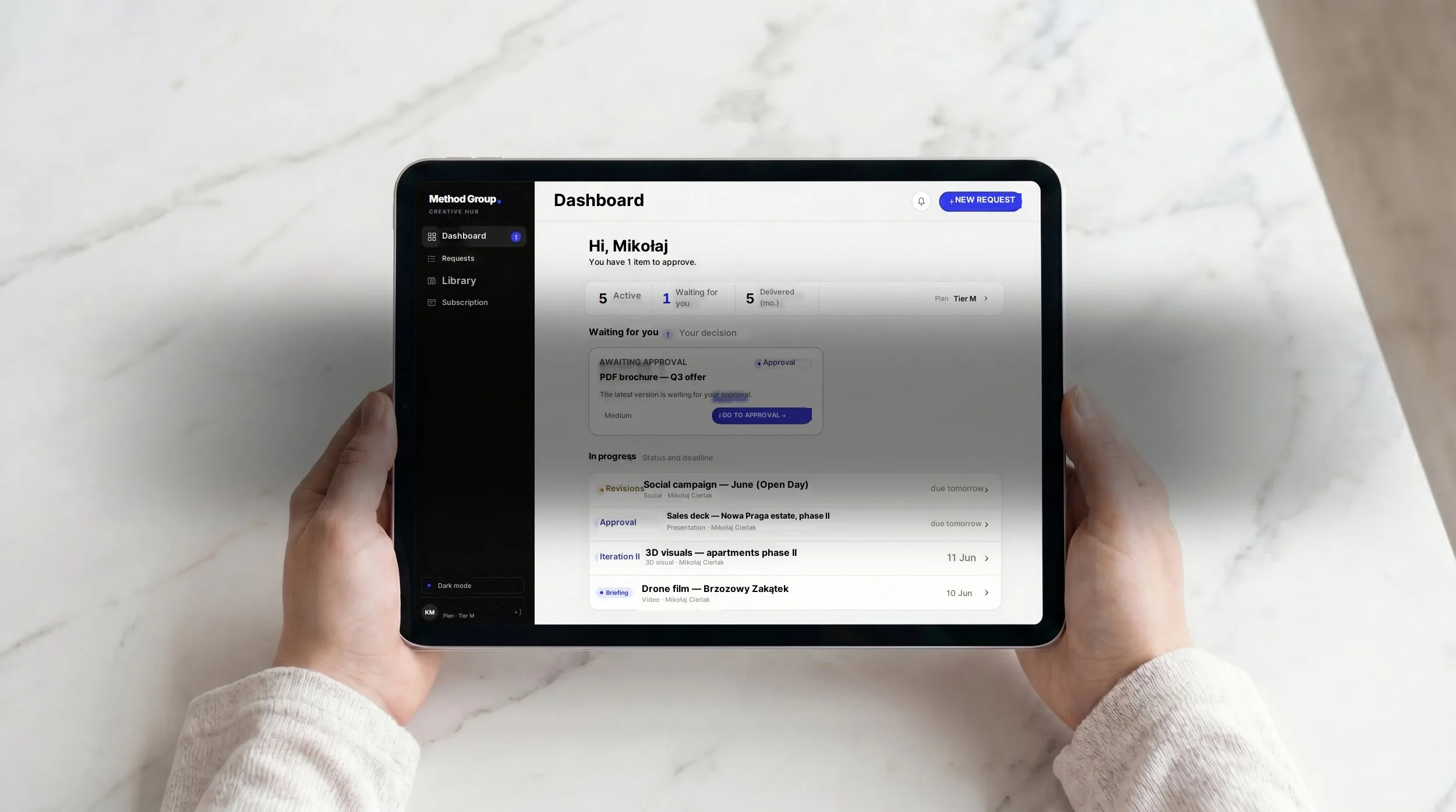
24/7 access for you and your team
See how it works: Method Creative Hub
To be fair: you don't always have to build your own.
If the process is standard and isn't your advantage — accounting, e-signatures, invoicing — take something off the shelf and don't overthink it. If the company is small and one owner genuinely sees everything, a system in their head is still enough. If you haven't the resource to maintain your own, a good standard beats an abandoned custom build.
A system built for the company earns its keep where the process is your advantage and where you're growing — in sales, customer service, producing material and the flow of decisions. That's where an off-the-shelf tool chafes fastest.
Polish companies are still early. That's a good thing.
Poland's statistics office reported that in 2025, 8.7% of Polish enterprises used AI, and only 5.0% used it to support marketing and sales. The Polish Economic Institute shows the difference by size: 42.0% of large companies, 15.6% of medium and 6.1% of small.
That's low. But I don't read it as cause for panic. I read it as a window. Because the larger the company, the less one person's productivity is enough. If the CMO writes an email faster, good — but sales may still be using the old catalogue and the board still doesn't know what's blocking the launch.
The real advantage starts when a system doesn't help one person work faster but helps the whole team see the same situation.
First step: a map before any automation
If I were to leave you with one thing to do after this piece, it's a simple map.
Take one process close to the money. Not the whole company. The launch of a development, say, or handling sales enquiries. Draw it without any tools: who starts, what they need, who decides, where the final version is made, where information gets lost today.
If you can't draw it, no software will fix it. If you can, only then is it worth asking about automation. Because automation isn't the first step. The first step is understanding what the system has to learn.
A system that learns your company — not the other way round

A dedicated team from day one
See how it works: Method Creative Hub
Companies think the advantage will come from a better tool or a better AI model. I think it will come from better context. Anyone can buy a model and software. The process, the decisions, the history of the material and a company's real knowledge won't arrange themselves. A system should learn your company. Not the other way round.
What next?
See how Method Creative Hub — puts the work in order from the first project, not from a big rollout.
Book a free call — I'll show you, on your own process, what the system should learn first.
Because the system was given an empty context. The new tool asked people to change how they think in order to fill in fields that make sense to software rather than to their day. At the first bit of pressure — a deadline, a sudden project, a colleague off sick — they went back to what worked. Excel didn't ask for context. It didn't require adaptation. It simply worked the way they worked.
The answer isn't better training or enforcing use of the tool. It's for the system to fit how the company already works from the outset — not the other way round.
After analysing over 300 initiatives, MIT NANDA finds that 95% of organisations got no measurable return from GenAI. KPMG's 2026 report confirms it: 95% of large companies have an AI strategy but only 8% achieve a real return.
The reason isn't technical. Companies bolt AI onto existing procedures without putting the flow of information in order. AI without a company's context answers nicely but won't run the work. It doesn't know which presentation is the latest, doesn't know the board's last decision, doesn't know which sales argument works.
An orderly flow first, then AI as a layer on top. Not the other way round.
This is the moment companies first feel that something is wrong. The team has grown, there are more developments, more clients — but the way it's all held together is left over from the previous phase. Decisions are in the owner's head, statuses in email, history in good intentions.
The first step isn't choosing a new tool. It's a map of one process close to the money, drawn without any software. Who starts, what they need, who decides, where information gets lost today. If you can't draw it, no software will fix it. If you can, only then do you know what to build and how.
At Pixelcraft, after a system was built around how the team already worked, visibility of the work rose from 30% to 95% and response time fell from two days to four hours. The team grew from nine to twenty-four people without losing control.
Start with the process, not the tool. AI amplifies whatever you give it — good context gives good results, no context gives nicely written chaos. Before rolling out any AI, it's worth answering three questions: where does knowledge live in the company, who has access to which decisions, and where does information get lost today.
Companies that get real results from AI don't start by buying a licence. They start by putting the flow of work in order, so the system has something to learn from. Only then does AI become a layer that speeds things up rather than another technology cost.
Take one process close to the money. Not the whole company. Handling sales enquiries, say, or managing the product range. Draw it without any tools: who starts, what they need, who decides, where the final version is made, where information gets lost today.
The basics can be up quickly. For a developer with four schemes and 65 apartments in Excel, a working system for units and enquiries was built in a day. No leads lost, the listing always matching reality. No migration, no big rollout — just a layer placed over what was already there.
The problem is that leads from different sources land in different places — the website form, email, the phone, a referral. Nobody knows which is urgent, which is waiting and which has already had a reply.
Rozwiazanie nie wymaga drogiego CRM-u dla deweloperow. Wymaga jednego miejsca ktore lapie kazde zapytanie i od razu je przydziela - bez recznego przepisywania i bez ryzyka ze cos wpadnie w szczeline miedzy mailem a Excelem. Taki system realizuje rowniez od 11 July 2025 wymogi ustawy o jawnosci cen mieszkan, ktora nakazuje deweloperom publikowac ceny i ich historie. Jezeli trzymales to w Excelu, teraz masz obowiazek prawny. System budowany pod Ciebie realizuje go sam.
A tool performs functions: it stores files, sends emails, reminds you about tasks. A system connects the work the way the company actually operates, and leaves a record of decisions.
The difference only shows under the first bit of pressure. A tool asks the company to adapt — people have to change habits to use fields that make sense to the software. A system asks for no adaptation, because it was built around how the company already works. There's nothing to roll out and police, because it simply fits.
Control is lost when knowledge of what's happening is spread across people rather than recorded in a system. The designer remembers the client dislikes a particular composition. The project manager remembers who approves the final version. The salesperson remembers a particular objection keeps coming back.
As long as those things live in individuals' heads, the company depends on their availability. One holiday, one illness or one departure and it's back to: who knows this, where was it, is it current.
A system that leaves a trace of every decision and every project lets you grow without losing control. Not because people are watched more closely, but because the knowledge stays — regardless of who is available.
For standard processes that aren't your advantage — accounting, invoicing, e-signatures — off-the-shelf software is the right choice. Don't overthink where you don't have to.
A system built for the company earns its keep where the process is your advantage and where you're growing — in sales, customer service, producing material and the flow of decisions. That's where an off-the-shelf tool chafes fastest, because it was designed for the average company. Your way of working isn't average.
One more test: if you can draw the process step by step with no tool at all, you know what to build. If you can't draw it, no software will fix it.
A system learns a company when every piece of work leaves a useful trace. A brief isn't only a description of a task — it's information about how a client thinks about their development and their goal. Feedback isn't only a revision — it's a decision about what the brand doesn't want. An asset isn't only a file — it's the current version marketing or sales can use.
When those things stay in email, only individuals learn. When they stay in the system, the whole company learns. And it can grow without depending on who happens to be available.