2026-05-10 · Blog
You spend on creative and don't know if it sells — how to change that
Details
Creative accounts for 49% of incremental sales — more than reach and targeting combined. Yet most companies never check whether their material actually helps a buyer decide. Here's how to change that.

Creative matters too much to guess at
Creative accounts for nearly half of sales performance, yet most companies judge material on taste rather than on how it works in a conversation. Creative Hub puts the making in order; Control Room shows whether the material actually helps a buyer decide.
Creative isn't decoration on a campaign.
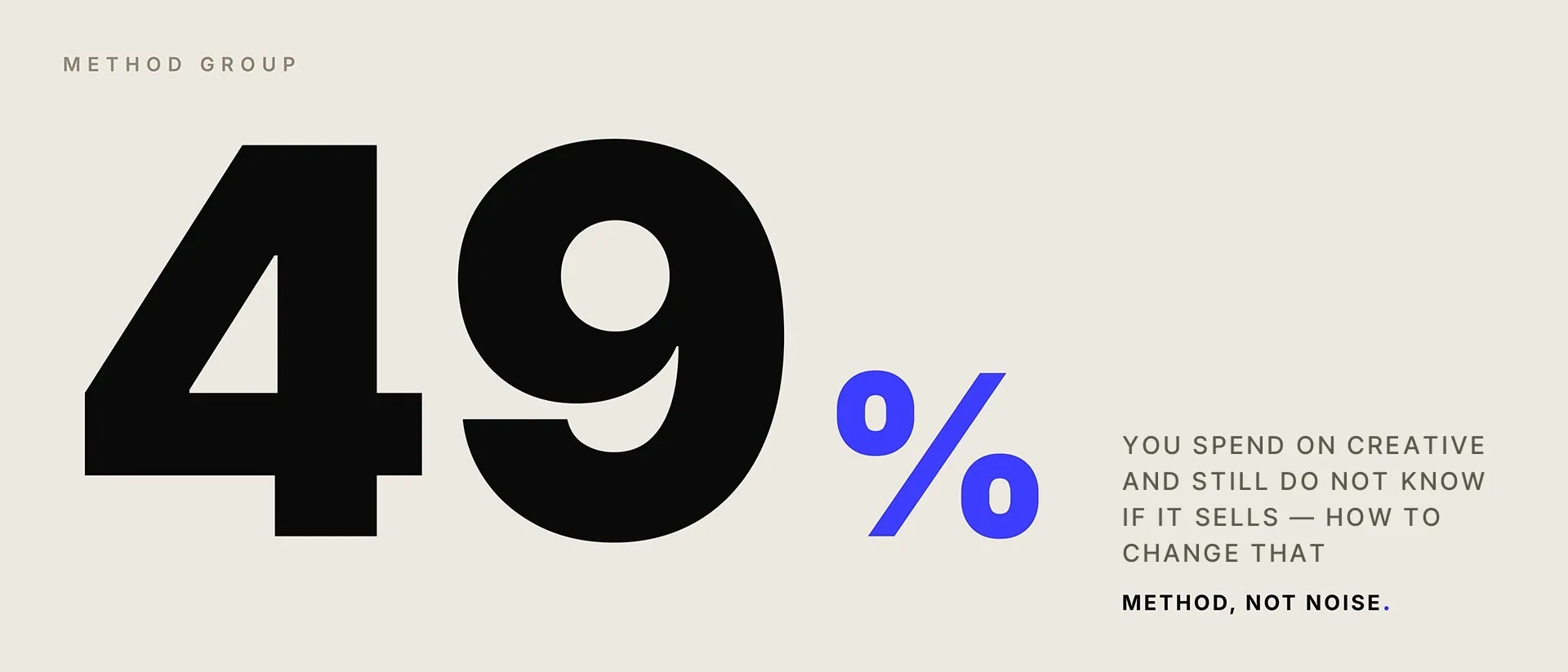
In its 2023 update to Five Keys to Advertising Effectiveness, NCSolutions analysed nearly 450 CPG campaigns. On that research, creative accounts for 49% of incremental sales.
That's more than reach, targeting and recency combined.
The conclusion is simple: if creative has that much influence on sales, judging it on impression alone is too shallow. Impression still matters, especially for premium brands. Material has to look good, hold the brand's level and build trust. But after approval comes a second layer.
Good material should help someone act. Leave their details, understand the difference, compare options, work through an objection, or come back after a meeting still holding the same story they heard from the salesperson.
If a company doesn't check, every new piece is partly an opinion. Sometimes a very good opinion. Sometimes an expensive one. Still an opinion.
Where the answer disappears
Your projects in one place
See how it works: Method Creative Hub
B2B research shows the scale of the illusion about cross-department working. 82% of leaders say product, sales and marketing are aligned. Only 41% say that alignment is genuinely strong.
In plain terms: companies have meetings, shared targets and reports, and feedback from sales conversations still comes back too late or too vaguely. Once in a comment. Once on a call. Once in a private message. Once not at all.
And a month later marketing hears: this presentation isn't working for us.
That sentence explains nothing yet. The material may be too long, too general, wrong for that point in the conversation, or excellent for the end customer and weak for the distributor. It may also be perfectly good, and sales simply doesn't know when to use it.
Without a shared place, that conversation quickly descends into taste, frustration and interpretation. With a well-designed loop you can go a level deeper: which piece, in which conversation, against which objection, with what effect and what change.
A training company: the advert was only the beginning
I was able to look at something similar first hand at a training company, where the creative didn't stop at the advert. The advert was the entrance to a longer path: a form, a page, an email sequence, lead scoring and the handling of people who entered the process.
One campaign brought over 300 applications from the advert. The email sequence had an open rate of around 41%. AI worked live across more than 600 leads.
The numbers are useful, but the mechanism matters more. If a lead from the advert hits a weak form, part of the effect vanishes. If the email after sign-up doesn't carry the same promise, a crack opens. If the team can't see which questions recur before purchase, the next creative may be prettier and still aim at the wrong place.
That's where the logic of Method begins. Creative Hub can deliver good material. Control Room should show whether it moved the buyer along, where they stalled and what to fix in the next round.
Premium developers and manufacturers share the same tension
At Method we mostly look at premium developers and premium product brands. Different industries, but the same thing happening underneath.
A developer sells the future: the scheme, the location, the specification, confidence in the completion date and a promise that matches what the buyer will see in a few years. A premium manufacturer sells a difference the customer has to understand: the material, the quality, the technology, the product's story, the case for a higher price and how it works in a real interior.
A render, a catalogue, a film, a landing page, a case study, a product sheet, a comparison, a partner presentation and an answer to an objection are all needed. Value only appears when the right person uses the right material at the right moment.
If an adviser on a premium scheme has no simple piece about the specification, they'll explain it from memory. If a premium manufacturer has nothing for the showroom salesperson or the distributor, the quality difference collapses into a vague “because it's better”.
These aren't aesthetic shortcomings. They're failures to translate creative into conversation.
An interiors studio: the sale starts before the conversation
On the surface it looked like booking paid online consultations. In practice it was the whole customer journey: choosing the service, payment, a pre-meeting questionnaire, a reminder, the conversation and a follow-up afterwards.
The cost of the booking tool fell from 400 PLN a month to nothing. Automatic reminders, questionnaires and emails around the meeting were added.
A small case, but a good lesson. Sales material isn't always a catalogue or an advert. Sometimes it's a service description, the name of a package, a form, an email before the meeting and a summary afterwards.
If the architect gets a good brief before the consultation, the conversation is better. If the client understands why they're filling in a questionnaire, they arrive better prepared. If the follow-up matches the conversation, the next step is easier.
In a process like that, creative stops being a folder of files. It becomes part of the sales experience.
What Method should do differently
24/7 access for you and your team
See how it works: Method Creative Hub
Method shouldn't be another firm that says: give us a brief and we'll make the material. That would be too shallow.
Method already has a scale it doesn't have to pretend to: 100M+ reach, 1000+ projects and large formats. My part is making sure that creative doesn't end up as a file.
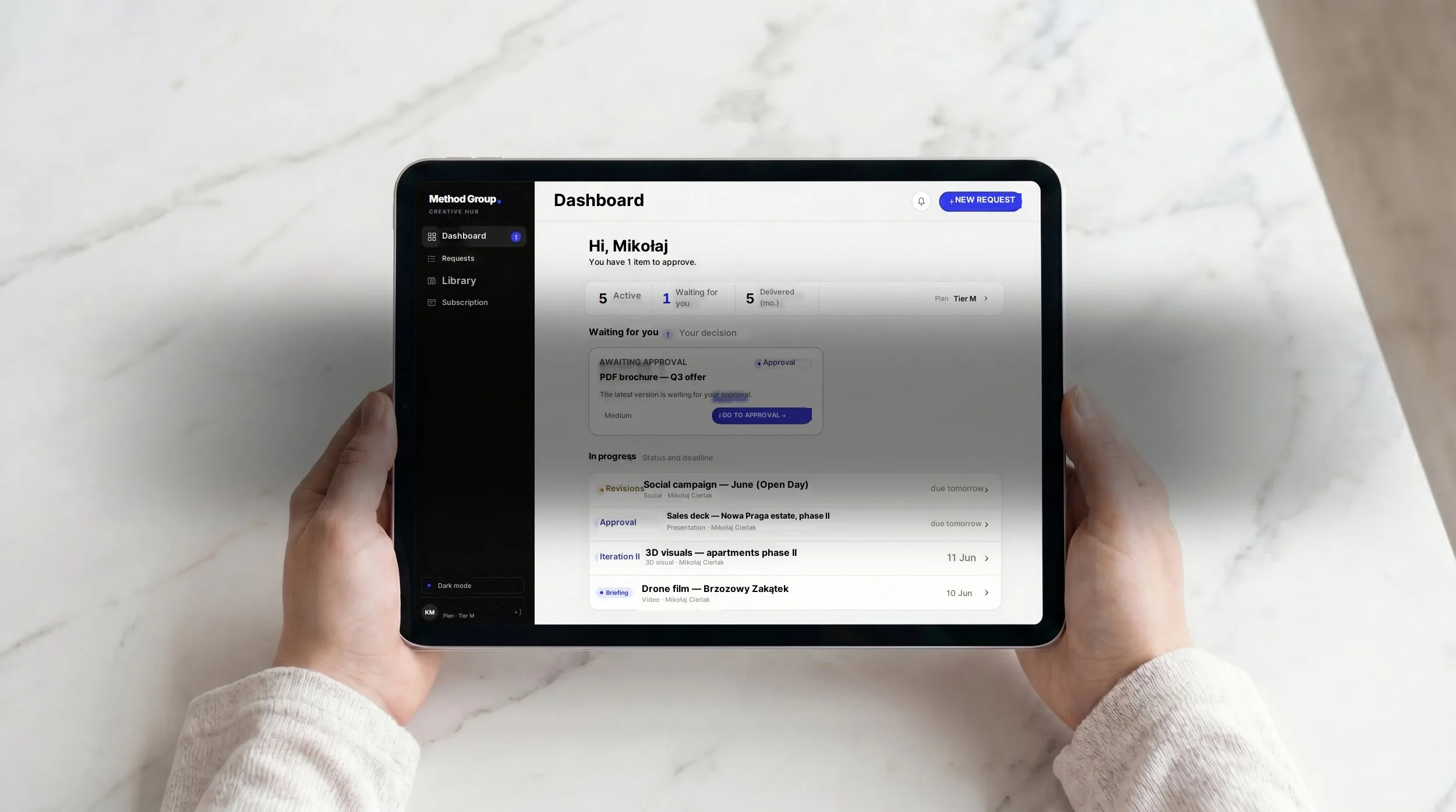
Creative Hub is there to give the work order. Control Room is there to make its use visible. In practice a piece should have a status, an owner, a context of use, feedback from sales, the objections it meets and a decision: it stays, it needs changing, or a new version is required.
This needn't be a heavy tool. In many companies the first sensible system is simpler than another monthly report. What matters is that the team doesn't have to assemble the answer from memory, Slack, a folder, the CRM and a status meeting.
The first move
If I had a day to check this in a company, I'd take the last three pieces made for sales: a presentation, a landing page, a catalogue, a product sheet, a film or a follow-up email.
Against each I'd write one sentence about who should use it, at what point in the conversation, which buyer question it answers, what feedback came back from sales and what changes in the next version.
If those answers are blank, the creative budget is hard to defend. Even when the material is good.
A company isn't buying creative. It's buying a better chance that the buyer understands, trusts and takes the next step.
Without a loop between creative and sales, that influence is invisible.
With a loop, every new piece can be better than the last, because the company can finally see how its own material works in sales.
Creative doesn't sell on its own

A dedicated team from day one
See how it works: Method Creative Hub
But good creative strengthens a sales conversation.
The question isn't only: is the material good?
The question is: do we know where and how it helps a buyer decide?
That's what this is building towards: Method. Creative Hub puts the making in order. Control Room shows use, feedback and blockages. And then the creative budget stops being an opinion about quality. It becomes part of the sales system.
See how Method Creative Hub makes and organises creative inside one way of working. Want to see whether your creative is genuinely working in sales? Book a free call and I'll show you how Control Room closes the loop between marketing and sales.
Yes — and it isn't a matter of opinion. NCSolutions analysed nearly 450 CPG campaigns and found that creative accounts for 49% of incremental sales. More than reach, targeting and recency combined.
In B2B the relationship is similar but less visible, because the sales cycle is longer. Material doesn't close a sale in one click. It helps a buyer understand the difference, work through an objection, come away from a meeting with something concrete in hand, or convince someone further up the organisation.
The problem is that most companies judge material on impression rather than on how it works in a conversation. Which is why a creative budget is hard to defend — even when the material is good.
It's one of the commonest problems in B2B. CEB research shows that sales teams don't use 80% of the content marketers create. Not because they're lazy. Because the material doesn't answer the questions that actually come up in sales conversations.
Marketing creates without knowing where buyers stall. Sales doesn't come back with feedback because there's nowhere to put it. And so, quarter after quarter, new material appears that nobody uses.
The answer starts with a shared place where sales can say: I'm missing this piece, buyers stall here, this objection comes up in every conversation. Without that loop, every piece of material answers a question nobody asked.
You don't need a big system to start. Three things are enough.
First: every piece has an owner, a context of use and a moment in the conversation it fits. Not a folder of files, but an answer to: who uses this, when and what for.
Second: sales has an easy way to give feedback. Not an email, not a Slack comment, not something mentioned at a quarterly meeting. One place, one sentence, one status.
Third: marketing can see which material is used, which sits untouched and which comes back with a request for changes. Without that visibility, every decision about the next piece is a hunch.
That's exactly what Control Room does — it closes the loop between what marketing produces and how sales uses it.
Sales feedback gets lost for three reasons. It arrives too late, it's too vague, or there's nowhere to record it.
Too late: marketing hears a month later that the presentation isn't working. Too vague: “this presentation isn't working for us” explains nothing. Nobody knows whether it's too long, wrong for that point in the conversation, or excellent for the end customer and weak for the distributor.
For feedback to be useful it needs a structure: which piece, in which conversation, against which objection, with what effect and what suggestion. Five fields instead of one Slack comment.
Companies that do this well don't have better marketing or better sales. They simply have one place where the conversation happens regularly rather than incidentally.
With five signals that sit close to the money.
First: is the material used at all — by whom, how often, at what point in the conversation. If you don't know, you have your answer.
Second: which objection makes a salesperson reach for it. Material that helps with no objection isn't working in sales.
Third: what's missing. Which buyer questions keep recurring with no ready answer.
Fourth: what happens after it's used. The buyer moved on, asked for a meeting, went quiet, came back a week later.
Fifth: what the decision is for the next version. The piece stays, needs changing, or has to be remade.
Campaign reports won't show you this. It's only visible when sales and marketing discuss the same data in one place.
A budget is hardest to defend when nobody knows what the material actually does. The board sees the cost of production and no clear answer to whether it works.
The starting point is changing the question. Instead of “is the material good?”, ask “did the material help the buyer decide?” The second has a concrete answer, provided sales gives feedback.
In practice, take the last three pieces made for sales. Against each, write one sentence about who uses it, at what point in the conversation, and what feedback came back. If those answers are blank, the creative budget is hard to defend. Even when the material is good.
With a loop between creative and sales, every new piece can be better than the last. And the budget stops being an opinion about quality. It becomes part of the sales system.
A premium developer sells the future: the scheme, the location, the specification, confidence in the completion date and a promise that matches what the buyer will see in a few years. The sales material has to hold that promise for the whole length of the buying decision.
In practice that means several layers. A render showing the specification and the feel of the scheme. A unit sheet with the layout, the floor area and the specification, in a form an adviser can leave with the buyer. A comparison of options that helps with the choice between a floor and a view. An answer to objections about the completion date or about the developer as a partner.
Value doesn't come from the quality of the material alone. It comes when the right adviser uses the right material at the right point in a conversation. If an adviser has no simple piece about the specification, they'll explain it from memory. Each of them slightly differently.
A premium manufacturer has two problems at once. It has to explain the quality difference to the end customer and at the same time arm the distributor or the showroom salesperson, who doesn't know that difference as well as the manufacturer does.
Material for a distributor isn't a catalogue sent by email. It's the answer to: what does the salesperson say when a customer asks why this costs more? What story do they tell about the material, the technology or how it's used?
Without that, the quality difference collapses into “because it's better”. Which isn't enough for a product that costs more.
Good distributor material contains specific arguments for specific objections, a comparison with the cheaper alternative and an example of use in a real setting — an interior, a project, a finished job.
Sales enablement means supporting sales with material and knowledge at the right moment. Not a one-off training course, not a folder of files, not a campaign. A continuous process in which the salesperson has what they need to hand before walking into a conversation.
In practice it's three things: current material matched to the stages of a conversation, knowledge of the typical objections and answers, and feedback returning from sales to marketing after every cycle.
Introducing it needn't start with a platform costing tens of thousands. One place where sales knows what to look for, and one place where they can report what's missing, is enough. The rest comes from consistency, not from a tool.
In most companies a data sheet answers “what is this?” A good sales sheet answers a different question: why is it worth it, and when do you choose it over the cheaper alternative?
The difference is who it's written for. For an engineer specifying a project it needs parameters, standards and a technical comparison. For a showroom salesperson it needs the language of benefits, one key argument and an answer to the commonest objection about price.
The same sheet for both audiences works well for neither.
A quick test: give the sheet to someone who doesn't know the product and ask what they'd say to a customer who asks why it's worth paying more. If they can't answer without further explanation, the sheet needs a second layer — a sales one, not a technical one.