2026-03-15 · Blog
CaaS vs agency vs in-house designer. Which model suits a B2B company?
Details
Freelancer, in-house designer, agency or CaaS? An honest comparison of four models of creative production — costs, drawbacks and the situations where each genuinely makes sense.

Freelancer, in-house designer, agency or CaaS?
An honest comparison of four models
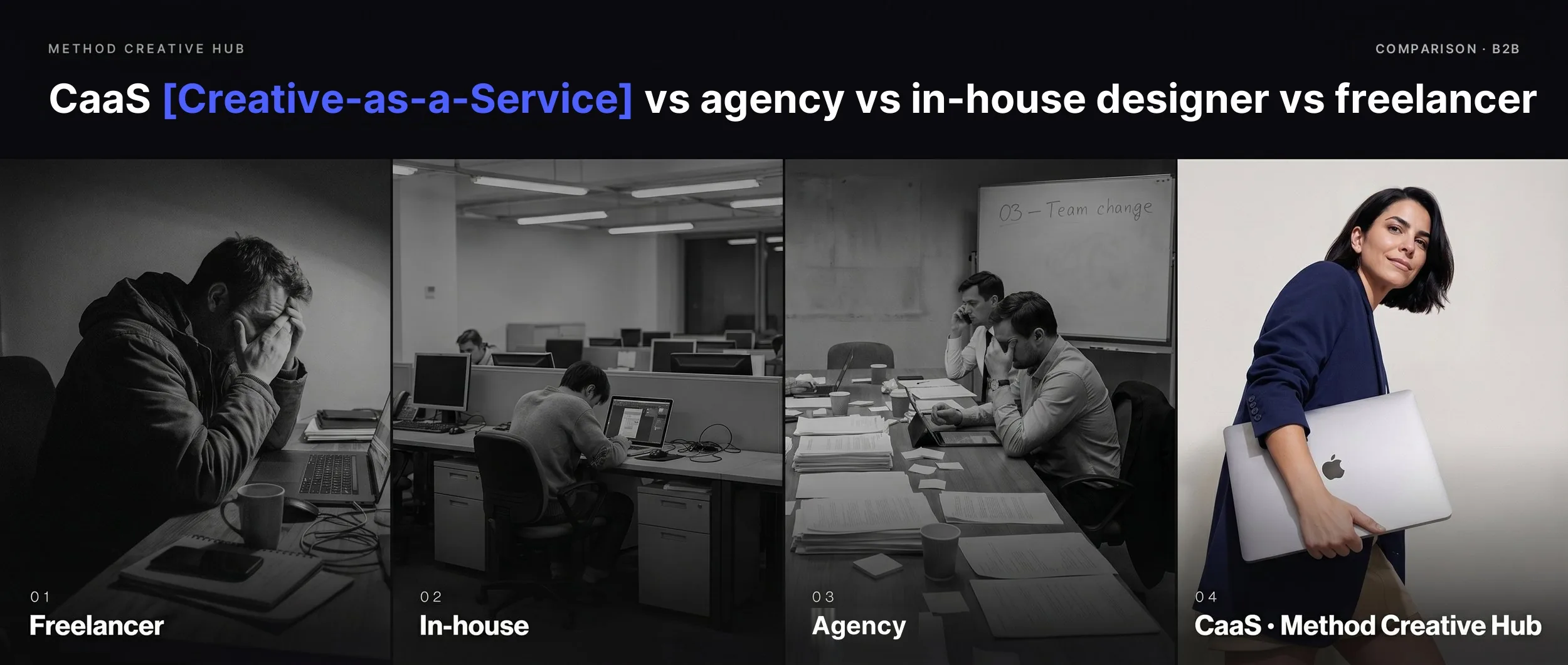
You have a problem with creative production. You know something has to change. You're looking at four options and don't know which to choose. Most articles on the subject are written by companies selling one of those models — so you can fairly guess how the comparison turns out.
This one will be different. We'll show when each model genuinely makes sense — including the situations where Method Creative Hub isn't the right answer. Before the detail, one sentence on each:
Freelancer — one person, one specialism, priced per project or per hour. Flexible but unpredictable.
In-house designer — a headcount, fully available, with deep brand knowledge over time. A high fixed cost and a narrow range of skills.
Traditional agency — a full team, a strategic approach, boutique quality. High costs, long processes, a retainer or per-project pricing.
CaaS (Creative-as-a-Service) — subscription access to a full creative team. A fixed cost, a broad range, production that scales.
When a freelancer makes sense — and when they don't
A freelancer wins when: you have a single, clearly defined job. You know what you want, you have time for it and continuity doesn't matter to you. A logo by yesterday. One graphic for a campaign. Copy for a landing page. Something that isn't a priority and doesn't hurt the brand if it slips.
A freelancer fails when: you need continuity and delivery on time. Freelancers take holidays, have other clients and their own priorities. If your campaign depends on material being ready on a fixed date, you're tied to one person's schedule. One holiday at the wrong moment and the campaign stops.
A further problem: a freelancer usually has one specialism. A good illustrator isn't a good motion designer. A good copywriter won't handle CGI. When your needs go beyond one field you need several freelancers, and managing them becomes a second job of your own.
When an in-house designer makes sense — and when they don't
An in-house designer (or team) wins when: the company has a very high, predictable and uniform volume of work in one specialism. Or when the brand is big enough to need a whole creative department rather than one person doing everything.
An in-house designer fails when: the company expects one person to cover the full range. This is the commonest mistake. There is no designer who is simultaneously senior in CGI, motion design, UI/UX and brand design. Each of those paths takes years.
Then there's the cost. Employing a senior creative in Poland really costs over 240,000 PLN in the first year — counting recruitment, onboarding, social security, software and training. For the first three to six months the company pays full cost without full output. And if the hire doesn't work out, it starts again.
When a traditional agency makes sense — and when it doesn't
An agency wins when: you want something genuinely exceptional and have the time and budget for it. A boutique agency with a real strategic approach can do things no other model reproduces — a campaign that takes your breath away, a visual identity that defines a category, a film that wins awards.
But that needs three things at once: a large budget, patience with the process and a client willing to be deeply involved. An agency at that level doesn't produce fast — it produces beautifully.
An agency fails when: you need a continuous stream of content within a predictable time and budget. Traditional agencies bill by project or by hour — every change of scope means a new addendum and another invoice. Approval processes take weeks. When something comes up suddenly there's no way to speed up without extra cost.
An agency is an investment in one big undertaking, not in continuous production.
When CaaS makes sense — and when it doesn't
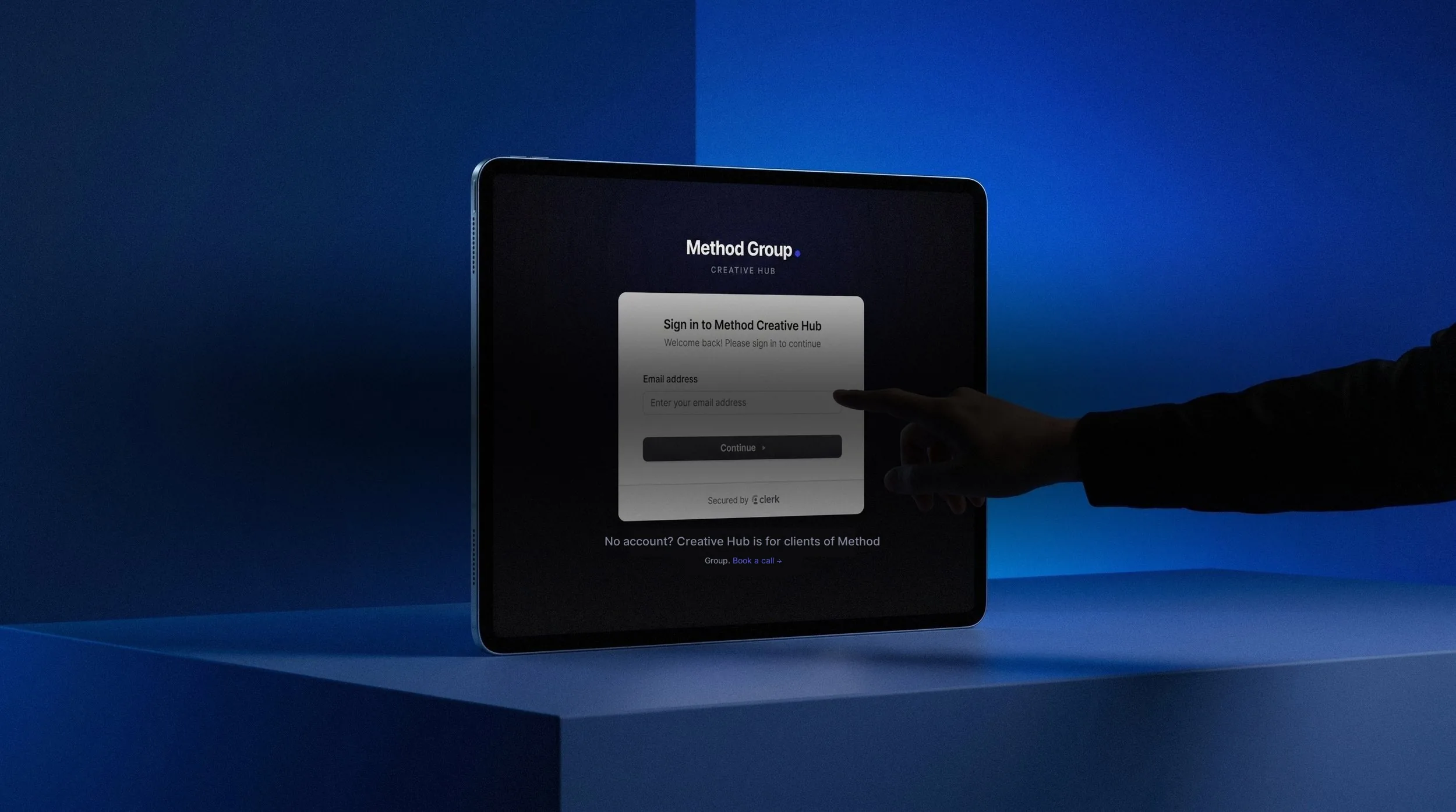
Your projects in one place
See how it works: Method Creative Hub
CaaS wins when: a company needs a continuous stream of material across formats and specialisms, at a predictable cost and without recruitment risk. When the list of creative work grows faster than capacity. When coordinating suppliers takes more time than the strategy does. When a brand wants to look consistent across every channel at once.
CaaS makes no sense when: you have one repetitive job and you're confident a particular person will do it regularly and on time without the brand suffering. If you need one graphic a month for an internal newsletter and you have someone who handles it, you don't need a production system. You need one person.
The full comparison — five key criteria
CaaS is at its strongest when a company is growing — because production scales with it, without recruitment and without renegotiating contracts.
*CaaS — Creative-as-a-Service
How to decide — three questions
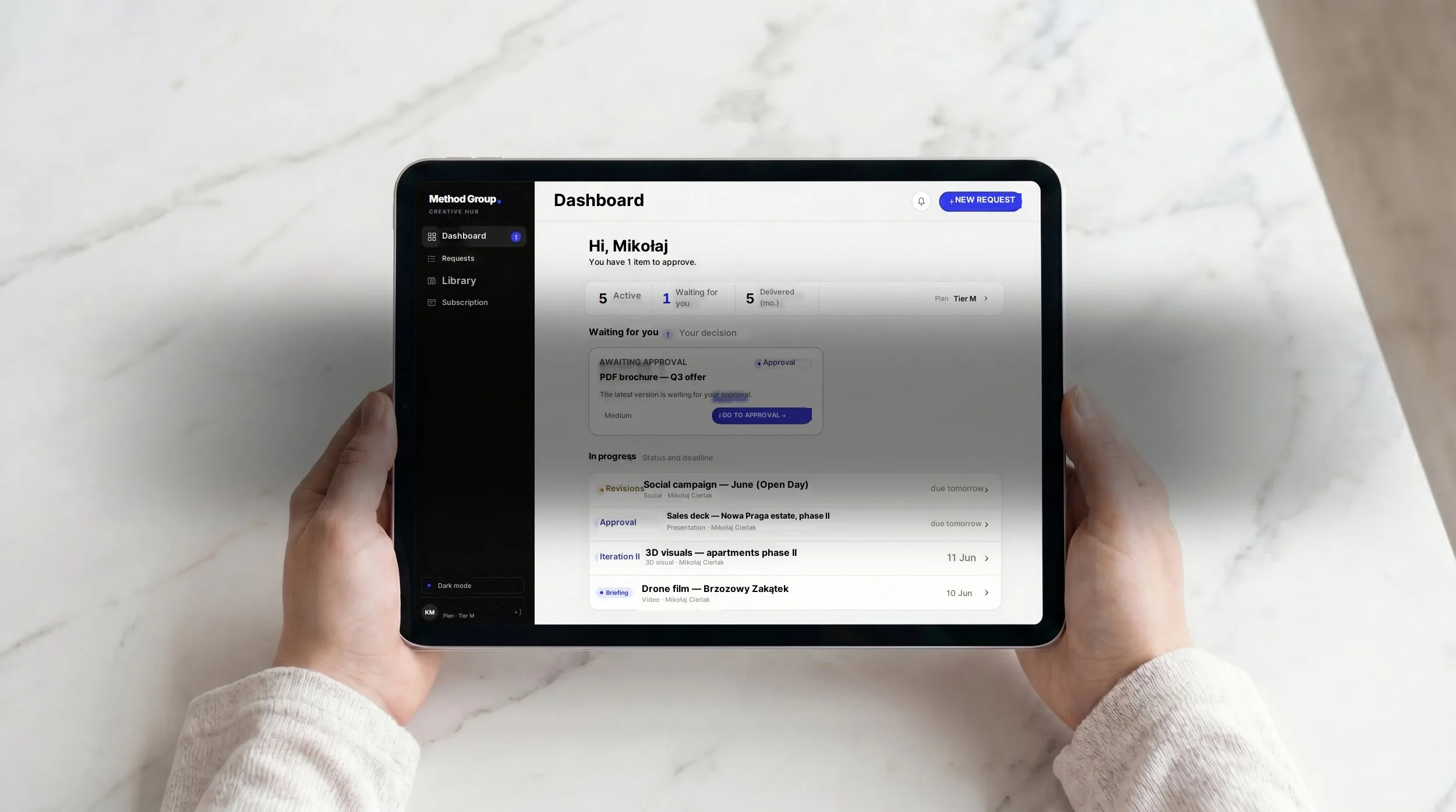
Round-the-clock access for you and your team
See how it works: Method Creative Hub
Rather than looking for which model is best — answer three questions about your own company:
How often do you need material?
Once a quarter — a freelancer will do.
Every week in several formats — you need a system.
How broad is the range of what you need?
One specialism — one person will do.
CGI, motion, web, social and advertising at once — you need a team.
How much does predictability matter to you?
You can afford delays — any model will work.
Campaigns have fixed dates and budgets — you need an SLA.
If you answered the first two questions with “often” i “broad”— then in all likelihood CaaS is the right model for you. If “rarely” i “narrow” — you probably don't need Method Creative Hub.
And that's the honest answer.
One-sentence summary

A dedicated team from day one
See how it works: Method Creative Hub
A freelancer is a tool for tasks. An in-house designer or team is an investment in one specialism. An agency is the apparatus for big campaigns. CaaS is an operating system for continuous production. The question isn't which is better — it's which one your company needs at this point in its growth.
If the answer is CaaS — see how it works: Method Creative Hub.
If not, come back to this article in six months.
It depends on scale and scope. An in-house designer makes sense when the company has a very high, predictable volume of work in one specialism. The problem starts when you expect one person to cover the full range — CGI, motion, UI/UX and brand design at once. A senior creative in Poland really costs over 240,000 PLN in the first year, counting recruitment, onboarding, social security and software. For the first three to six months you pay full cost without full output.
CaaS, or Creative-as-a-Service, is subscription access to a full creative team for a fixed monthly fee. Instead of hiring, recruiting and managing, you have a team ready to go. One subscription gives access to several specialisms at once: CGI, motion design, UI/UX, branding, advertising. Production starts within 24 to 48 hours, costs are predictable, and the scale adapts to your needs without renegotiating contracts.
At two points. First, when you need continuity and delivery on time. A freelancer takes holidays, has other clients and their own priorities. If a campaign depends on material by a fixed date, you're tied to one person's schedule. Second, when your needs go beyond one specialism. A good illustrator isn't a motion designer. Managing several freelancers at once becomes a second job of your own.
An agency is an investment in one big undertaking — a campaign, a visual identity, a film. It needs a large budget, patience with the process and willingness to be deeply involved. Every change of scope means a new addendum and another invoice. CaaS is an operating system for continuous production — a fixed cost, a broad range, a fast start. An agency produces beautifully; CaaS produces regularly.
Over 240,000 PLN in the first year. That isn't just salary — it's recruitment, onboarding, social security, software and training together. And for the first three to six months the designer isn't fully productive, because they're learning the company, the processes and the tools. If the hire doesn't work out, you start again at the same cost.
Yes — and those are the two segments where the model works best. A developer needs a continuous stream of material in many formats: renders, advertising, social media, sales material — simultaneously, to different deadlines, across different schemes. A B2B manufacturer needs consistency between catalogues, campaigns and material for trade partners. Both need a broad range of skills and a predictable cost — which is exactly what CaaS provides.
Production starts within 24 to 48 hours of onboarding. There are no weeks of briefs, pitch presentations and scope negotiations. You come in with the first job and the team starts working. It's one of the key differences from an agency, where simply getting a project started often takes weeks.
This is exactly where CaaS is strongest. Production scales with the company without recruitment and without renegotiating contracts. If you're launching a new development, entering a new market or starting another campaign, you don't wait three to six months to hire a senior. You adjust the subscription and production grows with the need.
Traditional agencies bill by project or by hour — every change of scope means a new addendum and another invoice. Approval processes involve several layers on both sides and take weeks. When something comes up suddenly there's no way to speed up without extra cost. An agency is designed for big one-off undertakings, not for continuous production at pace.
Yes — and it's the commonest arrangement among the companies we work with. The marketing department or director stays at the centre of the decisions: strategy, briefs, approving the direction. CaaS takes over the creative execution the department lacks the capacity or the skills to deliver on its own.
A developer's marketing director doesn't need another headcount. They need a team that delivers what they've planned — renders, the campaign, sales material — without managing five suppliers at once.
CaaS doesn't compete with your department. It acts as its delivery arm.