2026-04-19 · Blog
AI in marketing. Everyone has the same tools. Why do so few stand out?
Details
87% of marketers use AI. 71% of images on social media are AI-generated. If everyone is producing more, why do most brands look the same and why does nobody remember them?

Everyone uses AI. Which is why everyone looks the same. And why nobody remembers your brand.
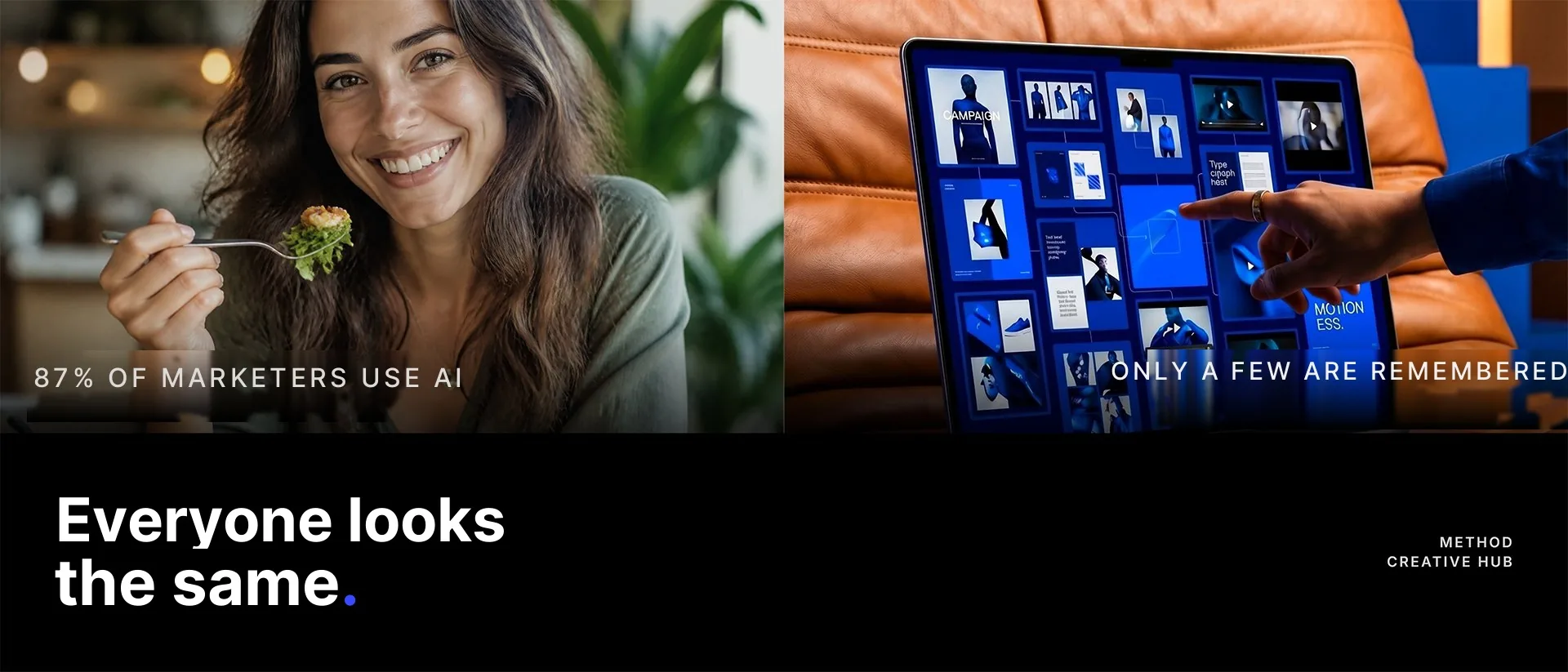
Since AI arrived in the creative industry, one thing has changed in conversations with clients. They used to say: “that looks Photoshopped”. Now they say: “that's AI”.
And they're right. More and more often.
I'm a fan of AI myself — as I would have been a fan of the internet, electricity and steam engines arriving. Each of those changed the world. AI is changing it now. There's no doubt about that.
But there's one thing that drives me up the wall.
The sheer amount of content shouting that AI does everything for us brilliantly. That you can generate 500 adverts in three clicks. That creative production has never been easier.
And technically that's true. The problem is that your competition has exactly the same three clicks.
AI has stopped being an advantage. It's become the standard.
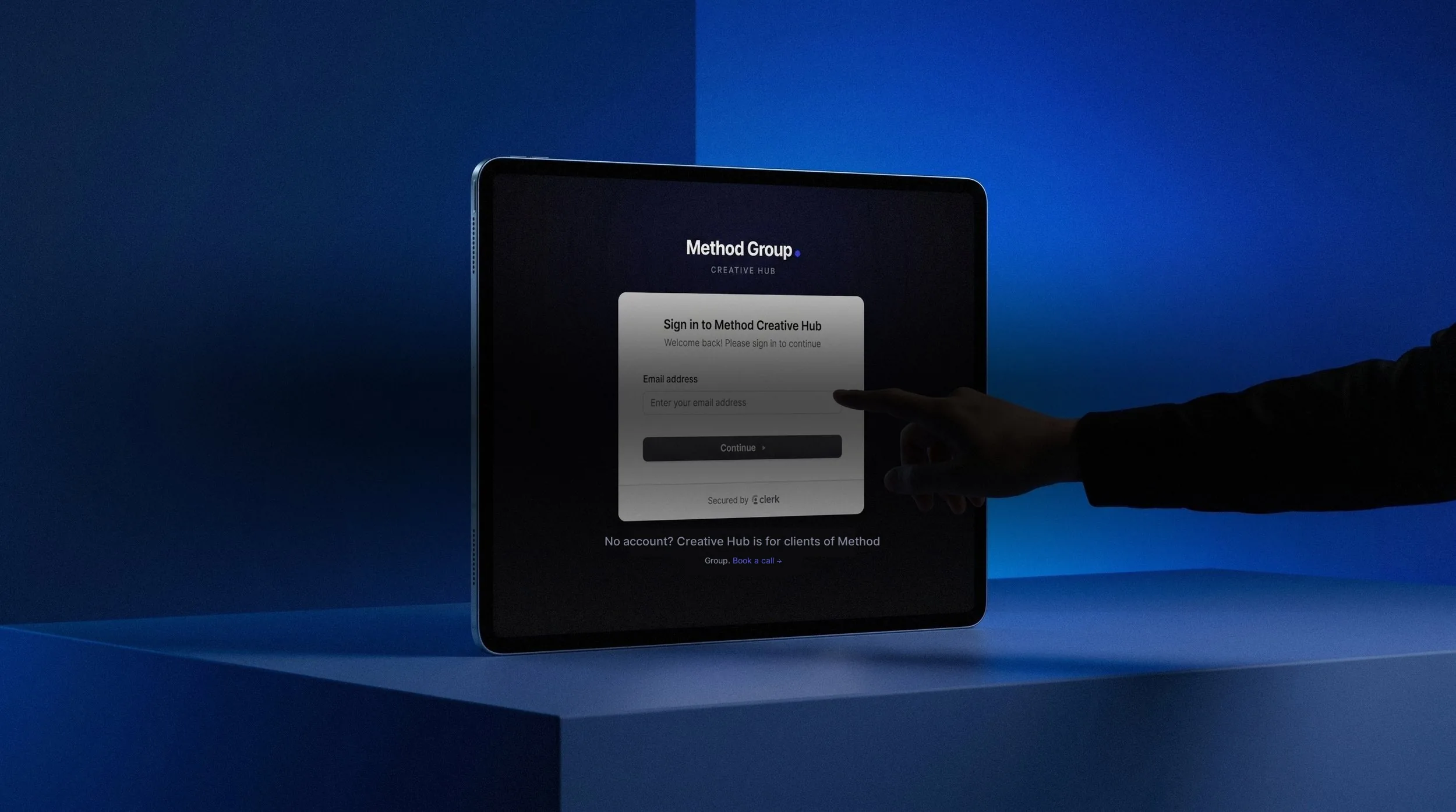
Your projects in one place
See how it works: Method Creative Hub
The numbers speak for themselves.
87% of marketers use generative AI in at least one workflow — up from 29% in 2021. 83% say AI helps them produce considerably more content. 71% of images shared on social media are now AI-generated. On LinkedIn, over half of long posts are probably machine-written.
Merriam-Webster made “slop” its word of the year for 2025, defining it as low-quality digital content mass-produced by AI. Mentions of AI slop rose ninefold in 2025 against the year before.
This isn't a future problem. It's what's happening now, in your customers' feeds, every day.
If everyone has AI and everyone produces more, AI has stopped being a competitive advantage. It's become the standard. The new minimum. What sets you apart is knowing what to produce, not producing fastest.
The problem isn't the tool. The problem is the input.
Let me ask three questions.
If you can generate 500 adverts in three clicks, how many of them will be tailored to your particular company's goals? Second: is it better to generate 500 adverts at once, or nine and test which perform better? If production is no longer expensive, perhaps it's worth trading quantity for quality and research?
And third: how do you know what to generate?
That's the question most companies skip. Because they focus on the tool — and a tool is only as good as the input you give it.
I have a concrete example from our own research. We analysed ad campaigns for a development project — three render variants of the same tower: day, night and winter. We tested them on two audiences, in Chicago and Los Angeles. Aged 25+, the same development, the same budget.
The result: the night render generated 20% more traffic in Chicago. In Los Angeles the gap was wider still — the night version drew 90% more traffic than the winter one. Cost per click for the winter version was 190% higher than for the night one.
The same product. The same tools. A different input — a different aesthetic matched to the audience and where they live.
Without that knowledge about the input, your AI generates more bad adverts faster than ever before.
AI amplifies whatever you give it — good and bad
That's the crux of it.
AI isn't bad. AI is an amplifier. If what goes in is a coherent view of the brand, a precise brief and an understanding of the audience, AI will produce excellent material faster and cheaper than ever. We've cut the time to make one render from four weeks to a week and a half — more than twice as fast as a few years ago. That time goes into experiments, art direction and thinking.
But if what goes in is an incoherent view, a brief written in five minutes and the assumption that AI will handle the rest, AI will produce more incoherent material faster than ever.
That's the paradox of scaling with AI. The faster you can produce, the more it matters that you know what you want to produce.
And that requires something no AI tool will do for you: a shared view of the brand inside the company.
Why most brands look the same
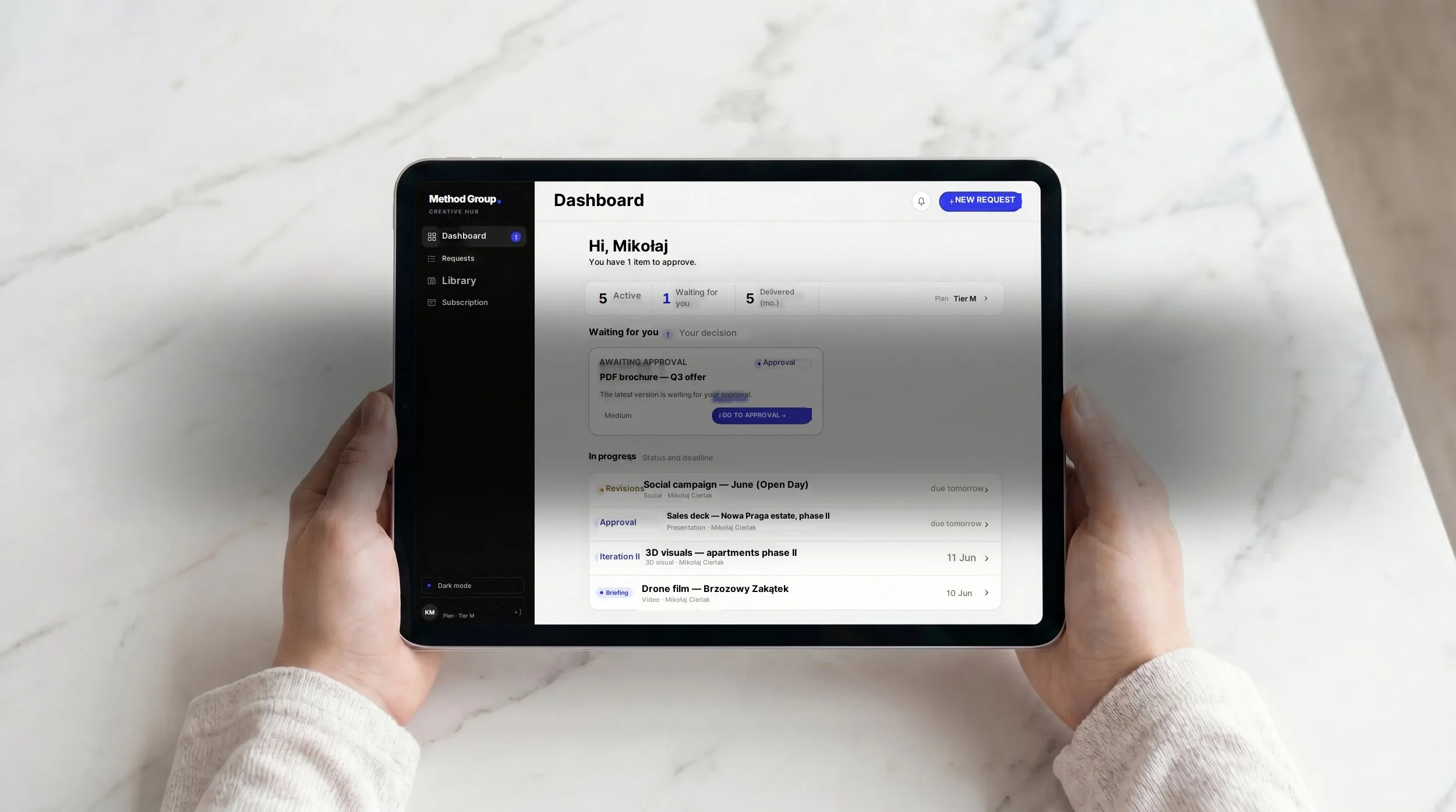
24/7 access for you and your team
See how it works: Method Creative Hub
Consumers are getting better at spotting AI content. Preference for AI-generated content has fallen to 26% — from 60% three years ago. 52% of consumers reduce their engagement with content they suspect is AI. 62% are less inclined to interact with AI content on social media.
Meanwhile the research is unforgiving towards brands that neglect consistency: brands with a consistent visual identity achieve 33% higher recall. A coherent cross-channel strategy translates into 23% higher revenue growth. Fewer than 10% of B2B companies claim fully consistent branding.
So: everyone is producing more. Consumers are tired. And a brand that looks consistent gets remembered.
That's your advantage. Not the tool. Consistency.
What to do to stand out in a world of AI slop
The answer isn't “use better AI”. The answer is: get the input right before you start producing.
In practice that means one thing: everyone senior has to speak about the brand in the same language. CEO, marketing, sales, design. If each understands it differently, every asset AI produces will reflect that inconsistency. Faster and in greater volume than before.
Which is exactly why Method Creative Hub starts every engagement with a visual communication strategy workshop. Not because we like meetings. Because without a shared input, everything produced afterwards — AI or not — burns budget.
Working the same hours we can deliver better results. But only when everyone knows what we're trying to achieve.
You can make a lot. You have to know what to make.
One test for today

A dedicated team from day one
See how it works: Method Creative Hub
Put one question to everyone senior in the company:
“If you had to describe our brand in three sentences to someone who doesn't know it, what would you say?”
If the answers line up, you have a foundation. AI will be your best production tool.
If everyone says something different, you know where that familiar effect comes from: plenty of content, little recall.
Method Creative Hub — we start with the input and end with assets people remember.
AI slop is mass-produced, low-quality content generated by artificial intelligence without a considered input or a view of the brand. Merriam-Webster made the term its word of the year in 2025.
In marketing it shows up as material that looks like hundreds of other pieces — no character, no consistency with the brand and no real effect on the audience. The main cause of AI slop isn't the AI tool but the absence of a good brief and a shared view of the brand before production starts.
The commonest reason is a lack of visual and verbal consistency — the material looks different in every channel because it comes from different suppliers with no shared direction. Research shows brands with a consistent visual identity achieve 33% higher recall. At the same time, fewer than 10% of B2B companies claim fully consistent branding.
If your brand isn't being remembered, start with one question put to everyone senior: how would you describe our brand in three sentences? If the answers differ, you have your answer as to why the material isn't working.
No — but it will change what you expect from one. AI is excellent at producing and iterating assets, but it won't replace strategic thinking about a brand, art direction, or the decision about what to produce at all. The agencies that survive will be those that understand their value doesn't lie in production — AI does that faster and cheaper — but in the quality of the input AI receives. The question worth asking your agency isn't “do you use AI” but “how do you define what to produce before you switch the tools on”.
Directly and measurably. Nielsen puts creative quality at 56% of a campaign's ROI — more than reach, targeting and budget combined. From Method's own research on developer campaigns: a night render of the same development drew 90% more traffic than the winter version in Los Angeles, and cost per click for the aesthetically weaker version was 190% higher. Same product, same budget, same target — different creative, entirely different results.
Which is why testing creative variants across a smaller number of assets works better than generating 500 adverts without knowing what works.
Paradoxically, start by producing less and concentrating on the quality of the input. If 87% of marketers use AI and everyone is producing more, the advantage isn't the tool but knowing what to produce. In practice: agree a shared view of the brand with everyone senior before you start any AI production.
Test smaller sets of assets matched to specific audiences and contexts instead of generating hundreds of variants with no hypothesis. AI amplifies the input — a good brief and a precise vision give excellent material faster than ever. A bad brief gives more bad material faster than ever.
Usually because it comes from different suppliers who read the brand differently — every freelancer, every agency and every in-house employee understands the brief slightly differently. The second reason is having no shared language about the brand internally: the CEO, marketing and sales often describe what the company is and how it should look in different terms.
When every piece comes from a different place with a different vision, the result is a brand that looks as though it belongs to several companies. The answer isn't another brief — it's a workshop that aligns the vision before anything goes into production.
Brand consistency means visual and verbal coherence across every point of contact with a customer — from the website through sales material to social advertising. It matters especially in B2B because buying decisions are long and multi-stage: the customer sees the brand many times before deciding.
McKinsey research shows a coherent cross-channel strategy translates into 23% higher revenue growth. At the same time fewer than 10% of B2B companies claim fully consistent branding — which means most are leaving that advantage on the table.
Fewer than you think. Generating 500 adverts in one click sounds impressive — but without a hypothesis about what to test and why, it's burning budget. A better approach is six to nine variants built on specific research questions: different aesthetics, different geographic or demographic context, different format.
If AI production is cheap, invest the saved budget not in more assets but in the quality of the data that tells you what works. Fewer variants, a better hypothesis, more to learn from.
Start with one simple exercise: ask everyone senior (CEO, marketing, sales, design) to describe the brand in three sentences to someone who doesn't know it. If the answers line up, you have a foundation. If everyone says something different, you have your answer as to why the material hasn't looked the way it should.
At this point it's worth running a formal visual communication strategy workshop that aligns that vision and defines what the brand can and can't do visually. Method Creative Hub starts every engagement from exactly this point — because without a shared input, everything produced afterwards burns budget.
A few well-tested ones — always. Especially now that AI has cut the cost of production to almost nothing. The logic of “let's make more because it costs nothing” floods your channels with incoherent assets that build no brand and produce no results.
A better approach: define what you want to find out, produce six to nine precise variants, measure the results, draw conclusions, scale what works. That way AI becomes a tool that genuinely accelerates growth rather than a machine for producing slop.