2026-08-07 · Blog
A product render as a deepfake? The AI Act in property development and in building materials and interior furnishings
Details
Article 50 of the AI Act took effect on 2 August 2026, with no transition period. What it changes for labelling AI-assisted renders — separately for developers and for makers of building materials and interior furnishings: the duties, who is liable, how to label.

Artificial intelligence has changed how construction and interiors marketing works. Generating greenery around a building, laying textures, staging a whole interior for a new tile or glazing collection. What used to take days now takes hours.
On 2 August 2026 the EU Artificial Intelligence Act came into force, changing the rules for publishing material of this kind. With no transition period.
Here's what that means in practice, separately for companies selling apartments and for those selling building, decorative and interior finishing materials and the like.
How to read this piece. We're relying on Regulation (EU) 2024/1689 and European Commission guidelines on Article 50 of 20 July 2026 (direct PDF, 51 pages). Every quotation carries its paragraph number so you can check it at source rather than take our word for it.
A note on the quotations. The Commission's guidelines were published in English only — there is no Polish version. Every quotation from the guidelines in this piece is our own translation, not official wording. If your lawyer is going to rely on something, have them work from the English text and the paragraph number. The Regulation does have an official Polish version, and we link to it above.
This is not legal advice. It describes the practice we've adopted ourselves. We don't know your material, your contracts or your processes, so this doesn't settle your particular case — decisions about your material are yours to make with your lawyer. The full disclaimer is at the end.
The new rules: transparency, not prohibition
The AI Act doesn't prohibit using AI. Nor does it limit how much you may use. It imposes one thing: a duty to inform the audience.
Whether someone is buying an apartment while the site is still a hole in the ground or choosing porcelain tiles or a glazing unit, they have a right to know whether they're looking at a real product or an image in which an algorithm added the surroundings.
The duty applies in two situations.
Material generated by AI. The background, the surroundings and sometimes the product itself come from a prompt or a working viewport, bypassing conventional rendering.
Material modified by AI. A far commoner situation. The basis is a conventional 3D render, often with the product reproduced faithfully from CAD files, but the model has drawn in people, decoration, light reflections, or generated the whole showroom setting.
The definition in the Regulation covers more than people. It expressly lists objects and places, and the guidelines add to objects buildings. Important for developers: the object needn't exist yet. Paragraph 113 says it is enough for it to resemble something that “exists, could plausibly exist or could plausibly have existed”. The argument that “this building is only being built, so I'm not misleading anyone” doesn't work.
That doesn't mean every AI file is a deepfake. The guidelines exclude two large groups: plainly unrealistic content, dragons and the like, and changes with negligible effect on the assessment of authenticity — colour correction, denoising, scaling, removing a passer-by who wandered into shot, even extending a background for aesthetic reasons.
The guidelines give an example that sets the line well. A real car shown in an advert against an AI-generated background is nota deepfake, provided the advert doesn't mislead about the product itself. But a generated image of the product that makes it look “more attractive or of higher quality than in reality” is.
So the line runs not through how much AI is in the frame but through whether AI touched the thing you're selling.
Where the biggest traps are — a few practical examples
1. For developers: drone photography
The riskiest point in development marketing is modifying real photographs of the site.
If an algorithm removes neighbouring building sites and temporary fencing from a drone photograph and generates a green meadow instead, the result is content that alters the facts about the surroundings.
The difference from an ordinary render is fundamental. There the basis is a 3D model. Here the basis is a genuine photograph of a real place. The buyer takes it as a photograph of the location.
This isn't solely an AI Act question. Unlabelled, such material invites an accusation of misleading buyers about the development's surroundings, and that exists in Polish consumer law independently of the new rules.
The same logic applies to interiors. The Commission gave it explicitly as an example when it published the official icons: a genuine photograph of an empty apartment furnished by AI requires an “AI modified” label.
Note what does not follow from this example. The Commission talks about photography because photography is the sharpest case — the material passes itself off as a record of reality. That doesn’t mean a render with generated furniture is automatically outside the rule. The definition covers objects that “could plausibly exist”, and the interior of an unbuilt apartment meets that. The guidelines contain no example settling the question of architectural renders, and that is one of the real gaps in what we currently know.
In that situation we label. Not because the rule unambiguously requires it, but because settling the question file by file costs more than the caption does.
2. For makers of building materials and interior furnishings: room sets
Manufacturers rarely show a product against white. Tiles and architectural glass sell in a finished setting.
And here's the thing that surprises people: a generated setting alone usually isn't decisive.
For example: if you generate a handsome modern living room out of AI's head to show how a tile sits with the light, you don't have to mark the file “AI Generated”. But if you photograph a genuine apartment in a specific development (an existing place) and AI paints in luxury furniture and your tiles, implying that this particular unit looks like that, you are into altering reality (deepfake / virtual staging) and it must be labelled.
The rule bites when the model touches the product itself. It has lifted the gloss on the stoneware, smoothed the grout, improved the grain of the wood, evened out the colour of a batch, tidied the finish on a profile. The product in the image then looks better than the one leaving the warehouse for the distributor — and that is a textbook example from the guidelines.
The practical consequence: the question to put to a 3D studio isn't “do you use AI”. It's “on which files did the model touch the product itself”. Everyone will dodge the first. The second can be checked.
Who is liable for a missing label: the studio or the client
There's a claim doing the rounds worth correcting, because half the articles repeat it: that liability sits with whoever publishes.
The guidelines say otherwise. The duty falls on the deployer of the deployer AI system, that is whoever decides on its use and how it is used. Paragraph 14 of the guidelines, quoted verbatim:
“By contrast, a company that merely commissions an advertising agency to produce an advertisement, without taking decisions and exercising control over whether and how the advertising agency uses AI in the production process, is not a deployer.”
Original: “By contrast, a company that merely commissions an advertising agency to produce an advertisement, without taking decisions and exercising control over whether and how the advertising agency uses AI in the production process, is not a deployer.”
So if you commission renders and don't decide what the supplier makes them with, the duty is theirs. Not yours.
Two things follow.
First: ask your suppliers whether they hand over material already labelled. Not whether they'll tell you.
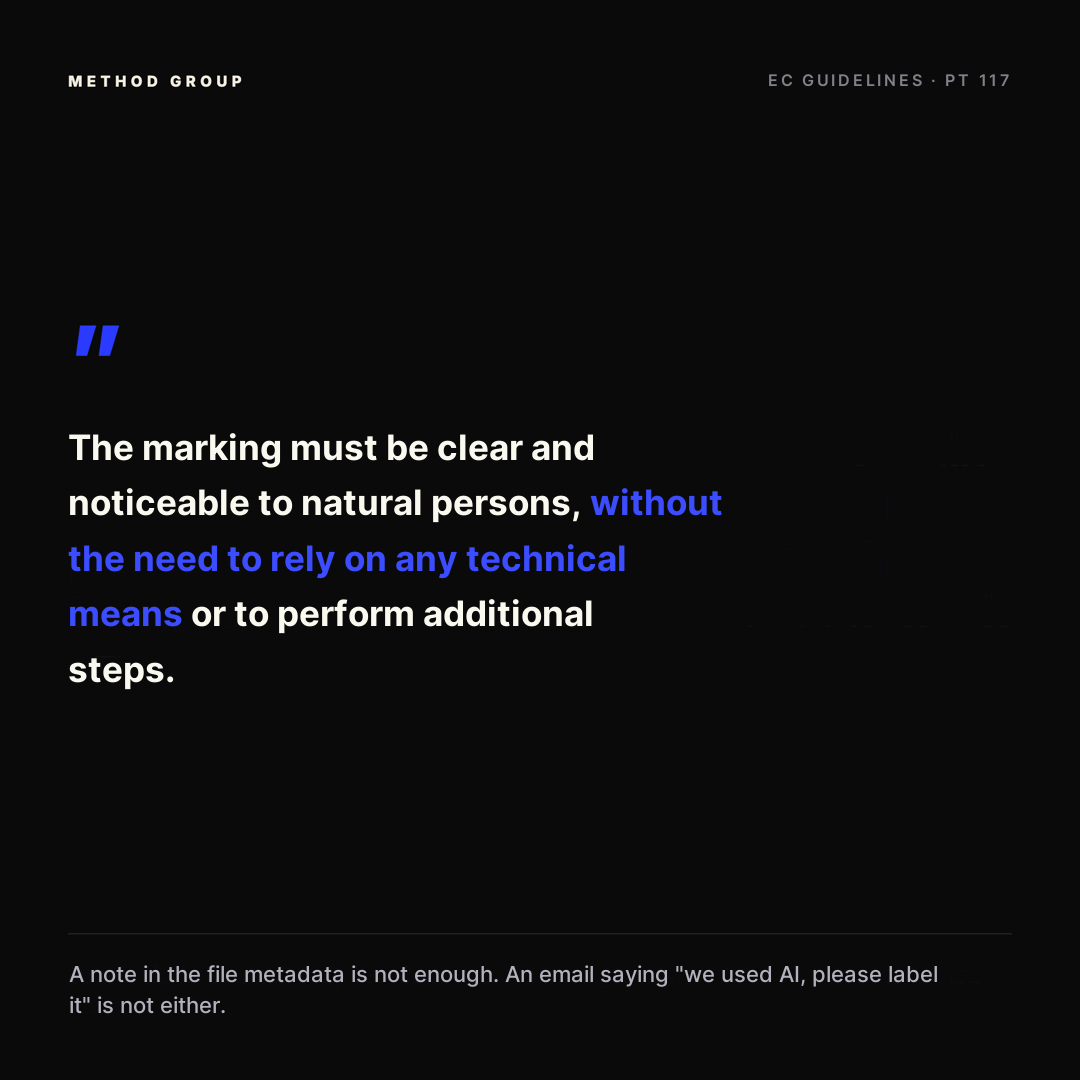
Second, and more important: a supplier who sends an unlabelled file with an email saying “we used AI, please label it on publication” hasn't discharged the duty. They've described it. Paragraph 117 states plainly that the duty is discharged by labelling the content itself. Such an email protects neither them nor you.
The role follows actual control, not who issues the invoice. The same paragraph 14 of the guidelines goes on to say that a legal person remains the deployer even when it outsources operation of the system to third parties — contractors or freelancers — acting on its behalf, under its responsibility and its control.
So if you knowingly commission AI-first material, or instruct someone to “generate some greenery around the building”, you stop being a company that “merely commissions”. The duty comes back to you.
In fairness it's worth saying where what can be quoted ends. The guidelines guidelines contain no sentenceexpressly stating that both parties can be deployers of a single piece of material at once. That's an inference from the definition of control, not a quotation. In practice it means the split of roles can't be settled in a contract once and for all — what counts is who actually decided on the particular project.
One thing is settled regardless of how the roles fall: hiding the information solely in the file's metadata isn't enough. The label has to be visible to the human eye at first contact with the material.
The penalty reaches €15m or 3% of worldwide turnover, whichever is higher.
In Poland oversight goes to KRiBSI, the Commission for the Development and Safety of Artificial Intelligence. The act was signed on 24 July and comes into force on 11 August 2026. Its chair will be named in October and the commission starts work in November. It will carry out inspections, handle complaints — including from consumers and competitors — and impose penalties.
This isn't a grace period. The duty has applied since 2 August, and material released in September will still be in circulation when the commission starts work.
Agree with the studio what the label should look like
Since the duty sits with whoever runs the model, they apply the label. But the material goes out under your brand, so it's worth agreeing the look once, at the start, rather than negotiating with every batch.
The good news: the rule doesn't dictate a form. Paragraph 34 of the guidelines says expressly that it prescribes “no specific disclosure technique”, and the deployer may choose any suitable one. There is no prescribed wording, typeface, colour, size or position in the frame.
The requirements are functional and come down to three things.
Perceptible without tools. Paragraph 117: the label must be “understandable and perceptible to natural persons, without the need to rely on any technical tools or take additional steps”. Which is why an entry in the file's metadata alone isn't enough.
Clear and distinguishable. Paragraph 142: noticeable, understandable and easily distinguishable from the rest of the information and from the environment the content is presented in. Text buried in terms and conditions, behind a dropdown or in an instruction manual doesn't meet that.

At first encounter. At the latest when the audience first sees the material — and that applies to every subsequent person at their own first contact.
Beyond that you're free. What's worth settling with the studio up front:
- wording — “Modified by AI” or “Generated by AI”, in Polish or in English for international material
- position and size — which corner of the frame, what point size, the same typeface as the rest of the captions
- an EU icon variant — whether at all, which of the three, and in what colour
- small formats and video — what goes on a 300×250 banner and what goes on a film
In practice, for us it looks like this: short text in the corner of the frame, “Modified by AI” or “Generated by AI”, in the same typeface as the rest of the captions. On video, the same wording visible throughout rather than a title card at the start — viewers often join halfway. Where a synthetic voiceover sits over untouched footage, you label the voice, not the whole video.
What to avoid whatever you agree: phrases like “technology-assisted” or “using modern tools”. They don't convey that the content came from AI, so they don't discharge the duty.
It's one conversation at the start. After that the label is part of the template rather than a decision made file by file.
If for some reason you need files without a label applied, because you have your own labelling system or your own layout, that's something to settle with the supplier in writing, together with who ensures the label is there on publication. It isn't a situation the guidelines describe, so every studio handles it its own way.
What about working versions?
A common question, because it concerns daily work: does a file sent for approval mid-process also need a caption?
Under the rule, no. Paragraph 68 of the guidelines excludes outputs used solely within a closed production loop, naming advertising production:
“Outputs that are only used in closed loop environments in industrial and product development workflows (for example for film, animation, games or advertising production), unless they are the final output (...). In those cases, only the final output from workflow stages has to be marked.”
So the duty concerns the final material, the one that reaches the audience. Not every intermediate stage.
In practice it's worth labelling working versions too, and we do. The reason is purely operational, not legal: work-in-progress files reach social media far more often than anyone plans. Somebody posts “a teaser from production”, the file lives on, and nobody remembers it was a version for approval.
If the caption on a draft gets in the way of judging the work because it covers part of the frame, the answer is to move it, not remove it.
Ready-made labels from the European Commission, and where to get them
For small formats there's a ready-made solution. On 10 June the Commission published an official set of three badges. Free, in SVG and PNG, in four colour variants (black and white, each at full opacity and at 50% transparency), with no attribution required.
You can download the set directly from the European Commission's site — in Polish too.
The Commission describes their use as follows:
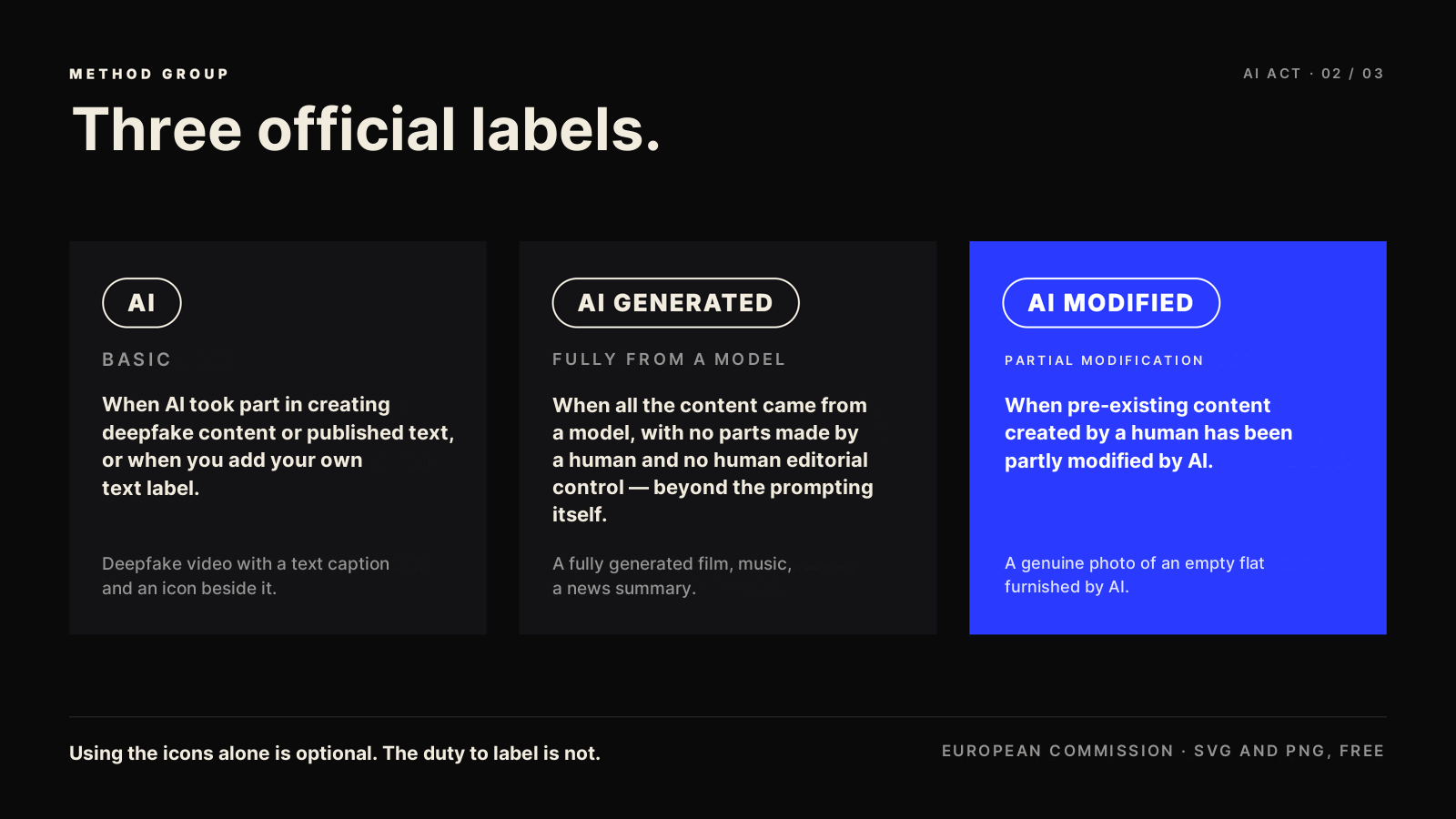
Three things from the Commission's guidance on these icons that people most often ask about.
The word “AI” on its own is a valid label. It's the official label, and the Commission recommends avoiding abbreviations other than “AI”.
An icon with text works better than an icon alone. The Commission user-tested this, and comprehension improves on every measured dimension when the basic icon is accompanied by a text label. Where there's room, use both.
Using the icons themselves is optional; the labelling duty is not. From the Commission's site: “Use of these EU symbols is optional, but the labelling requirements set out in Article 50 of the AI Act are not.”
If you publish on a website, the Commission additionally recommends that the alt attribute also state that the content was generated or modified by AI. That's an addition to the visible label, not a substitute — on its own the alt doesn't discharge the duty.
What to avoid: “technology-assisted”, “using modern tools”. Such phrases don't convey that the content came from AI, so they don't discharge the duty.
What you don't have to do
There's more good news here than the headlines suggest. What follows are general rules — with any particular piece of material the context decides, so treat them as a starting point for a conversation with your supplier and your lawyer, not as a settled answer.
You don't label images and video retrospectively. Material produced before 2 August 2026 stays as it is. With text it works the other way round: a text written before 2 August but published after that date has to be labelled. That is the easiest place to trip up if you have finished material sitting in a publication queue.
You don't stick labels onto printed catalogues. Paragraph 154 of the guidelines cites “modifying already printed product packaging” as an example of disproportionate effort that isn't expected. You add the label at the next print run and the matter is closed.
You don't label a pure rendermade without a generative model, even if it looks like a photograph. The process counts, not the appearance.
You don't label marketing copy. The duty for text applies only to material informing the public on matters of public interest. A development description and a product sheet aren't in that category — but note the exception, because the guidelines exclude marketing copy “not containing claims relating to health, consumer safety or sustainability”. Copy about a carbon footprint, an energy rating or an ESG report falls within scope. That mainly affects manufacturers.
How to get ready
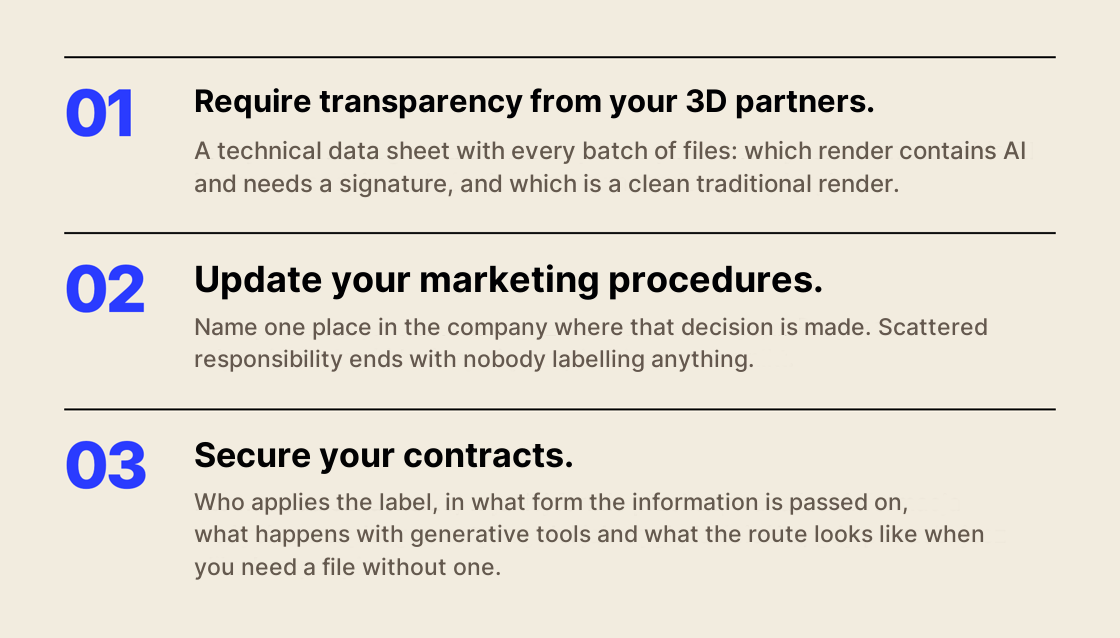
Demand transparency from your 3D makers. Ask for a technical schedule with every batch of files: a list of which renders contain AI and need a caption, and which are pure conventional renders. It's one page, and no serious agency should have a problem with it. If they do, that's information in itself.
Update your marketing procedures. The people responsible for the website, product catalogues and social media need to know that any image with AI elements carries a legible notice. Decide on one place in the company where that call is made — responsibility spread across marketing ends with nobody labelling anything.
Secure your contracts. Check whether your contracts with 3D suppliers specify who applies the label, in what form the use of generative tools is disclosed, and what the route is when you need a file without a caption applied.
Finally
Transparency doesn't kill sales. A buyer who sees a caption under a render gets a signal that the company isn't hiding how its material is made. In a year it will be standard across the industry.
It is worth knowing where the real uncertainty lies. The rule speaks of a material alteration but nowhere defines the threshold. Nor is there any case law — the Commission's guidelines say of themselves that they aren't binding, and only the Court of Justice of the EU can give a binding interpretation. The Polish authority hasn't issued a single decision.
So with high-reach material it's better to have a written policy than to decide on the fly for each file. We've adopted a binary rule: if a generative model was involved in production, we label; if not, we don't. Without weighing up what percentage of the frame came from AI. That's stricter than the rule requires and it's our decision, not a legal obligation. The arithmetic is asymmetric: a caption costs a line of text, its absence up to 3% of turnover.
If you want to work out how to adapt to the new rules, book a free consultation.
No. It requires material to be labelled where a generative model was involved in making it. What it restricts isn't the amount of AI in the frame but the absence of information for the audience.
When AI has touched the product or object you're selling, so that it looks real or better than reality. A generated background or setting around a faithfully reproduced product usually isn't decisive on its own.
The deployer — whoever decides on the use of AI and how it is used. If you merely commission material and don't decide what the supplier makes it with, the duty sits with them. If you knowingly commission AI-first material, the duty comes back to you.
No. Paragraph 117 of the guidelines says the duty is discharged by labelling the content itself, visibly to the audience. An email to the client or an entry in the file's metadata isn't enough.
The rule doesn't dictate a form. It must be perceptible without tools, clear, distinguishable from the rest of the content and visible at first contact with the material. The Commission provides free icons: AI, AI GENERATED and AI MODIFIED.
Under the rule, no — the duty concerns the final material that reaches the audience. In practice it's worth labelling working versions too, because work-in-progress files reach social media more often than planned.
You do not label images and video produced before 2 August 2026. With text it is the other way round: a text published after that date has to be labelled, even if it was written earlier.
Up to €15m or 3% of worldwide turnover, whichever is higher. In Poland supervision will fall to KRiBSI, the Commission for the Development and Safety of Artificial Intelligence.
Disclaimer. This is not legal advice and does not replace consulting your own lawyer or analysing your particular case. It describes the practice we have adopted at Method Group.
We don't know your material, your contracts, your processes or how your suppliers work. This text is not an audit, a legal opinion or confirmation that anything complies with the rules. Assessing any particular piece of material always requires looking at that material and at the context of its publication. Decisions about your material are yours, made in your own name and at your own risk.
What we're relying on: Regulation (EU) 2024/1689 and European Commission guidelines on Article 50 of 20 July 2026. The Commission's guidelines are not law — they say so themselves at paragraph 5 — and only the Court of Justice of the EU can give a binding interpretation of the AI Act. As at the date of publication there is no case law on Article 50, and the Polish supervisory authority has not issued a single decision. The interpretations set out here may differ from those an authority or a court adopts.
Some of what is described here is stricter than the minimum the rule requires. That applies in particular to labelling every piece of material involving a generative model. It is our internal operating standard, adopted on a risk calculation, not a legal requirement.
Stan wiedzy na 7 August 2026. This text is not updated automatically. The rules, the guidelines and the practice of the authorities will change — check at source before acting.
Sources
- Regulation (EU) 2024/1689 (the AI Act), Polish version
- European Commission guidelines on Article 50 of 20 July 2026 · direct PDF, 51 pages
- EU icons for labelling AI content (page in Polish, files to download)
- The Commission's FAQ on the transparency obligations
- The text of Article 50 with commentary
Linki sprawdzone 7 August 2026.